Choose one warp end, one weft pick and the square where they cross. Follow the warp through the threading and the weft through the treadling, then use the tie-up to decide which yarn should show on the upper face. Take that prediction to the cloth and turn the sample over. One crossing that you can read on both sides is a better starting point than a whole page of squares whose orientation you have guessed.
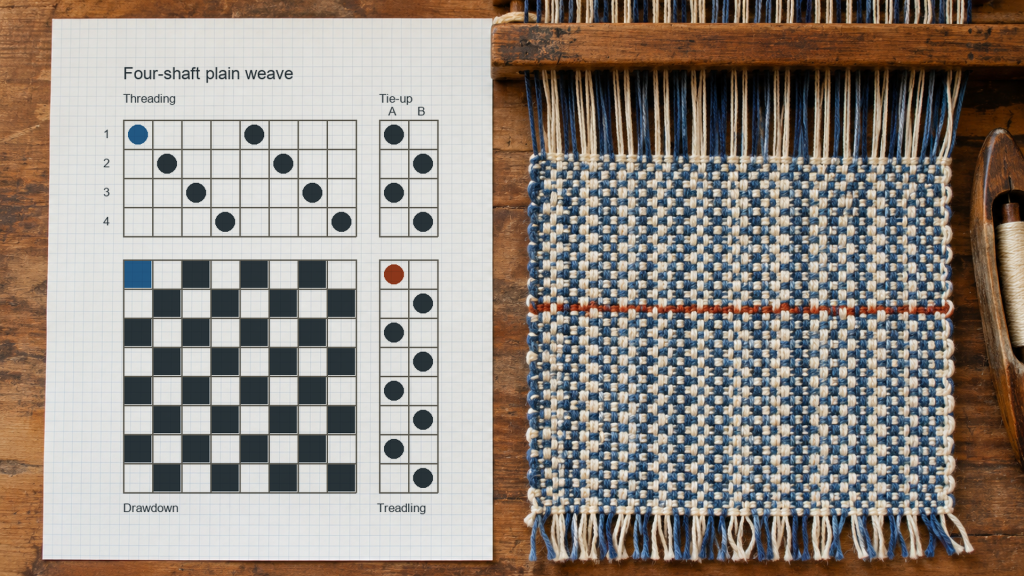
Featured image generated with AI. The teaching draft uses two treadles and four shafts.
Set a blue-and-cream sample beside its draft. For the exercise here a blue thread runs lengthwise and a single rust-coloured pass cuts across it. The contrasting colours make the crossing easy to retrieve. On a sample woven entirely in one colour, two loose threads laid alongside the edges can serve as pointers. Keep a separate note of what you put there yourself and what was actually woven into the fabric.
Agree on which way the draft is being read
A draft holds several pieces of information close together. The threading diagram assigns the lengthwise yarns, or warp ends, to shafts. The tie-up tells you how treadles connect to shafts. The treadling tells you what the weaver pressed for each pass of the crosswise yarn, or weft. The drawdown is the grid predicting which yarn comes to the upper surface at each crossing. Find all four before interpreting the dark squares.
Ask the weaver which corner starts the threading and which way the treadling runs. Also ask which face they meant the drawdown to show. Schacht Spindle Company’s instructions for reading drafts distinguish the four parts and explain the importance of a rising or sinking shed. The shed is the opening through which the weft passes. Knowing whether a marked connection lifts specified warp threads or lowers them is essential to predicting which thread you will see.
In this teaching draft, read the ends from left to right and picks from top to bottom. Number the four shafts from one to four. The marks in the tie-up mean that pressing the treadle lifts the indicated shafts. A dark square in the drawdown means warp above weft. Write that small legend on the working copy. If the maker’s own notation differs, replace the legend with theirs and start again from its first marked corner.
Find one lengthwise thread and one pass across it
Locate the blue warp end in the threading. Each vertical column belongs to an end. A mark on the row for shaft one tells you where that particular end was threaded. In the simple example, the threads pass in turn through shafts one, two, three and four, and the order repeats. One trip across those four columns is a threading repeat. A shaft can therefore hold many ends that move together, even though you are following just one of them.
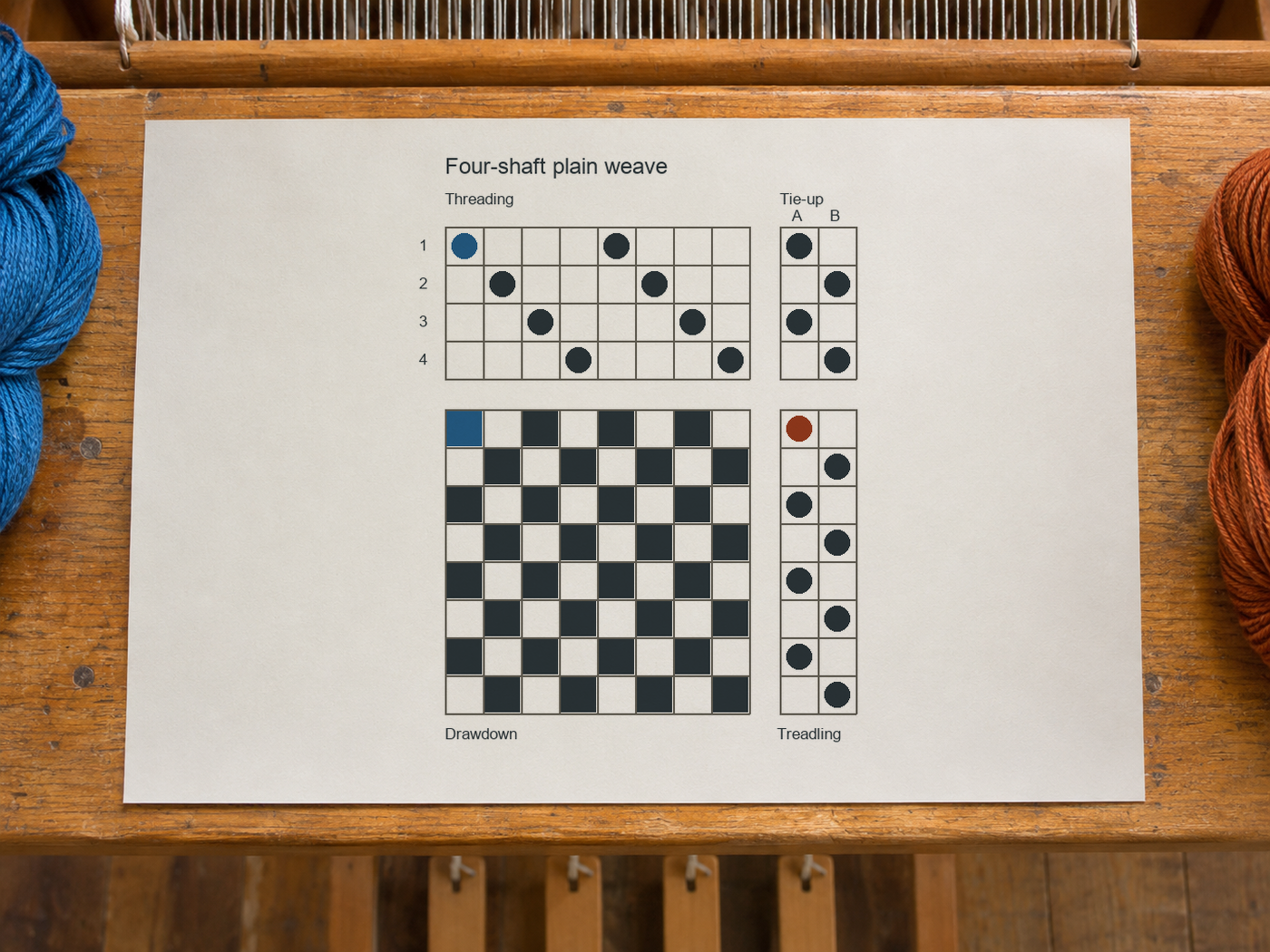
Along the side of the draft, find the row for the rust weft pick. A pick is one pass across the warp. The treadling row identifies the treadle used on that pass. Follow a straight line from the row to its treadle column and then into the tie-up. It is easy to jump by one row where a narrow chart puts its borders close together. Two slips of plain paper, one along the row and one along the column, make a reading window you can move without marking an original.
Before looking at the answer in the drawdown, say what the loom will do. Treadle A in this rising-shed exercise lifts shafts one and three. Treadle B lifts shafts two and four. The example uses A on the first pick, B on the next, and repeats. The blue end is the first end, on shaft one. If the rust pick is the first pass and the weaver presses A, that blue end rises and the rust yarn passes beneath it.
Predict the neighbours as well as the crossing
Mark that one square on a copy of the drawdown. In the teaching draft it should be dark. Now move horizontally by one column while staying on the rust pick. The next end belongs to shaft two, which stayed down on treadle A. Rust passes over it. Move one square vertically instead, staying on the blue end. For the second pick treadle B lifts two and four, so the blue end on shaft one stays down. The change in both directions is the characteristic over-and-under alternation of this example.

The two neighbouring checks are useful when a cloth contains a colour stripe. A strong blue vertical can look continuous at a glance even when it dives beneath every second pick. Seeing the alternation either side of the selected square gives you a way to locate a real crossing, rather than choosing the darkest point anywhere along a stripe. Repeat the exercise on the fourth end if you wish. It belongs to shaft four, which rises on B in this tie-up.
Suppose another weaver hands you a draft that uses filled tie-up cells for shafts pulled down. Copying those same filled cells into the rising-shed reading would reverse which set of ends you expect on top. Resolve the convention with the maker or an explicit key first. If the draft directly lists the shafts to lift for every pick, it may be a liftplan. Read the shaft list for the chosen pick there in place of looking for a treadle connection.
Take the two coordinates to the fabric
Find the warp direction from the maker’s orientation mark, a known selvedge or the ends of the warp if they remain. Identify the first end used in the working grid. A border or an extra floating selvedge can add threads before that point. Count them separately. Then find the particular rust pick and follow it across until you reach the selected blue end. A blunt pointer held above the cloth is enough. There is no need to pull a yarn out of a finished or borrowed sample.
At the upper face of the chosen crossing you should see the blue yarn bridging the rust pick. Watch it go under the adjacent pick. Turn the cloth like a page, keeping a finger or a small removable edge marker aligned with the same place. On the reverse of that very crossing the rust yarn appears over the blue. The edges reverse position when you turn the cloth. Recounting from what now looks like the left can quietly take you to a different end.
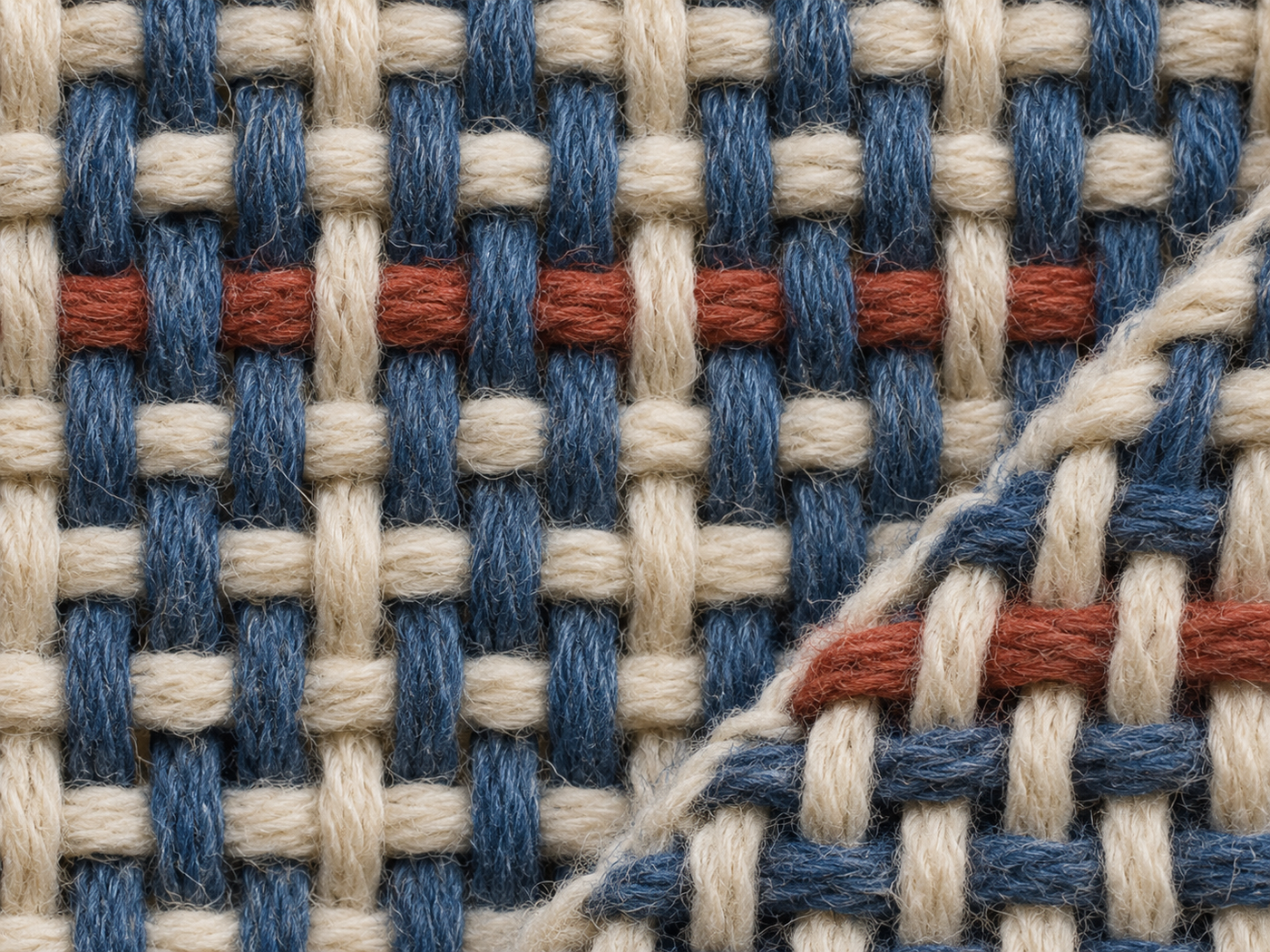
When the weave is fine, use magnification and a light placed off to the side. Shadows can expose the small ridge of a yarn passing over another. Change the direction of the light before changing your interpretation. A shiny yarn sometimes appears pale where it catches the light even though it is the dark-coloured thread you are following. Check the actual path into the adjacent crossing and make your note from that relationship.
Explain a difference without assigning blame
Start with the easiest things to check. Has the sample been rotated or turned over? Did the threading diagram begin on the opposite side? Did a border add an end or a header add a pick before the repeat began? A one-square error in a plain-weave example can reverse the apparent result everywhere. Test a second crossing a few ends away before deciding that the cloth and draft are different versions.
If a difference stays in one vertical line through many picks, inspect the threading entry for that end. If it runs across a single pick, examine the treadling instruction and ask the weaver about that pass. If a whole block differs, look at repeats, tie-up and whether the sample was actually woven from the version in hand. These are places to look. A finished sample alone rarely tells you who made a change or whether it was deliberate.
The maker might explain that the rust pick was added after the written sequence as a marker for a class. That changes where you start counting. They might instead identify a repaired warp end or a second drawdown printed for the reverse face. Add their explanation to the card with the date, and keep your first observation. It is valuable to know the difference between a prediction made from the chart and the extra information that eventually made the cloth legible.
File the sample so someone can repeat the reading
Give the draft and sample the same identifier, note the particular loom convention, mark the face and starting edge, and draw a small outline locating the selected crossing. Add the warp colour and shaft, the weft colour and pick, the treadle, and which yarn showed on each face. For a shared collection, label the orientation of a touchable textile sample so the next person receives it the same way up.
Your final entry for the exercise can be a single observation. Shaft one rises on treadle A, so at the first end and first pick the blue warp crosses over the rust weft on the upper face. The reverse exposes rust at those same coordinates. Another reader can now pick up the cloth, find the two threads and check your reading with their own eyes.

By Alma Quillan