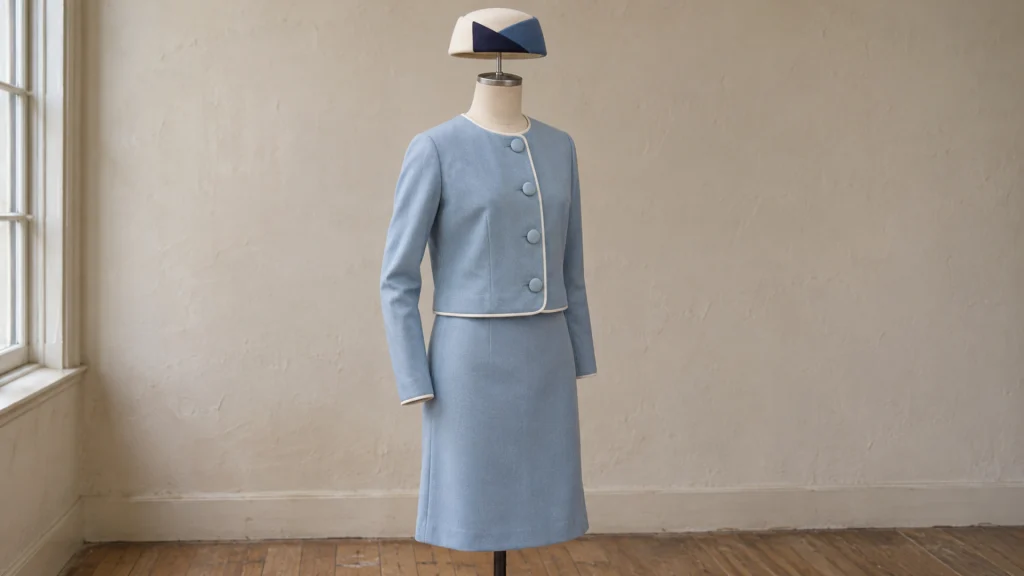
Illustration of the general Expo 67 hostess ensemble designed by Michel Robichaud, based on the McCord Stewart Museum’s garment photograph. AI-generated image.
Three women in neat jackets walk across the grounds of Montreal’s Expo 67, handbags in hand. Behind them rises the inverted pyramid of the Canada Pavilion. The McCord Stewart Museum dates the photograph to 1967 and names Danièle Touchette, Jean Murin and Lyse Michaud. Imagine being the visitor with a question. The coordinated clothes tell you that you can approach. To know whose pavilion an attendant represents, you need one more clue than the building behind her.
Featured image generated with AI. It reconstructs the general Expo uniform designed by Michel Robichaud.
General hostesses in light blue were stationed across the fairgrounds, and individual pavilions had their own staff. Robichaud designed a blue uniform for the general hostesses employed by the Canadian Corporation for the 1967 World Exhibition. The Québec Pavilion dressed its hostesses in brown and pale blue, in a design by Serge & Réal. Both answers survive in cloth. For what a visitor could actually ask the women, there is also the testimony of two people who did the job.
The blue jacket in the collection
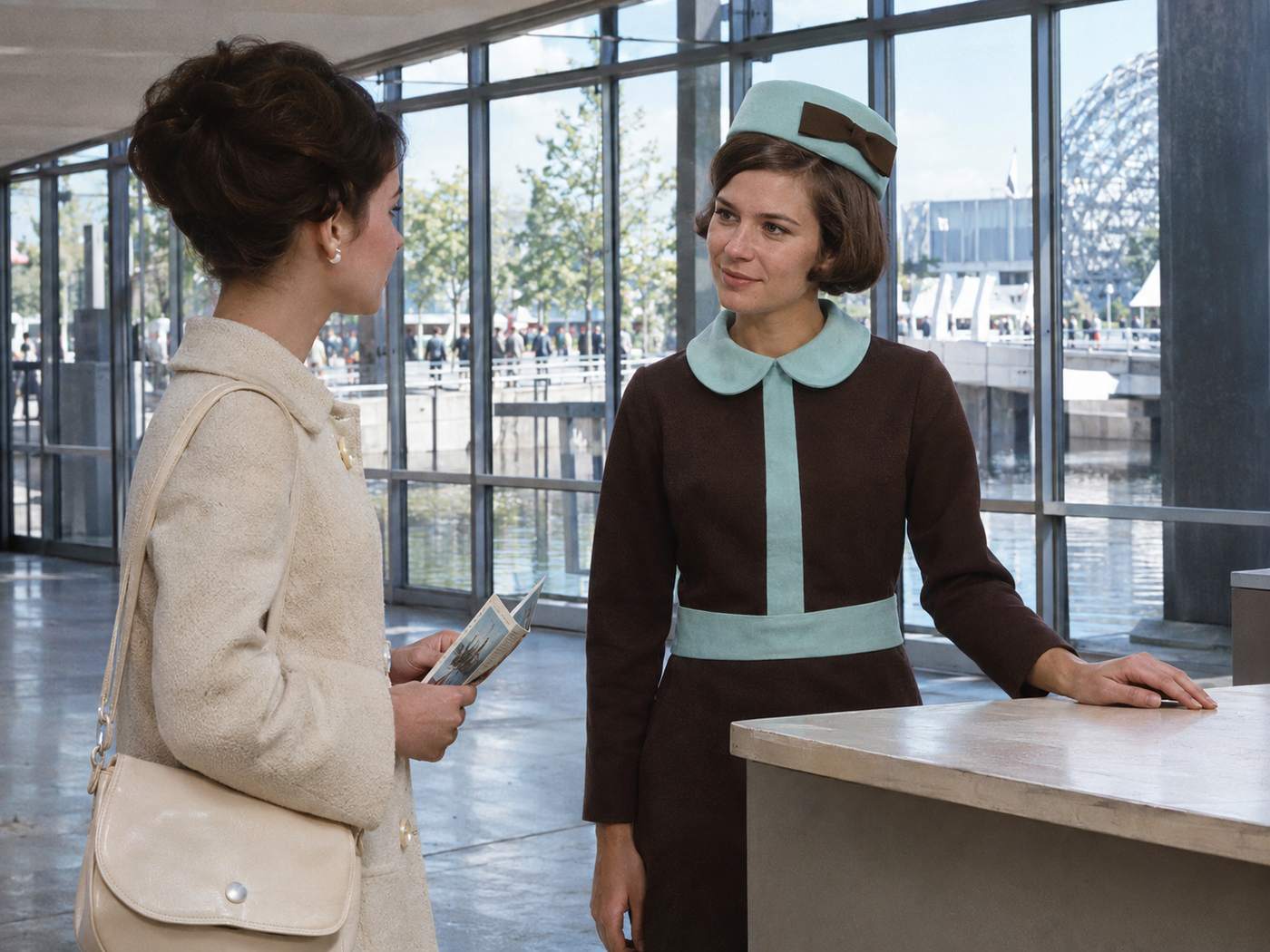
Find the McCord Stewart Museum’s photographs of the two uniforms and begin at the bottom of the page. The hem falls in a clean line below the matching blue jacket. Four round buttons lead the eye up to a fine pale edge at the neck. From farther away the cap does more of the work. Its contrasting panels break up the blue, right where somebody looking across a crowd might see them.
The museum identifies this ensemble as object M2012.50.1, parts 1–4. That number fixes which version you are looking at. Robichaud also designed uniforms for hostesses assigned to several pavilions, including Canada’s. A label bearing his name, or a souvenir described simply as an Expo hostess dress, leaves room for more than one answer. A photograph of it beside the identified museum garment gives you something firmer to work with.
Follow the pale blue band
Move up the museum page to the brown ensemble. The light collar meets a band running down the centre front, then turns through a right angle at the waist. You can follow it at a glance. In a black-and-white family photograph, where two quite different colours may come out a similar grey, that change of direction is a better clue than trying to guess a dye colour.
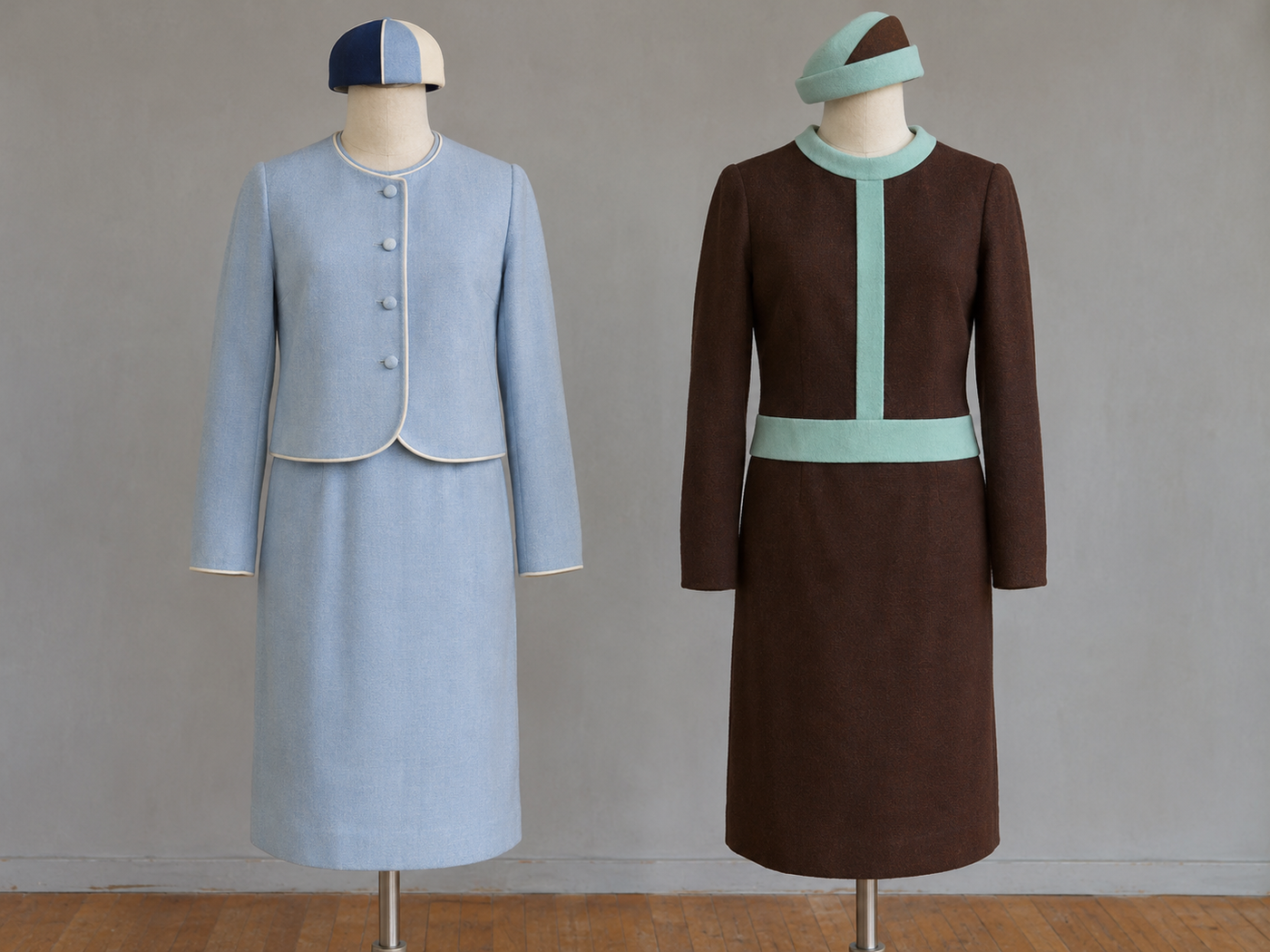
The museum records the Québec Pavilion ensemble as M967.93.1–2, a gift from the pavilion. Its Montreal collection catalogue identifies wool gabardine in the dress and jacket, and felt in the hat. It is worth keeping the object number with a sketch of that front band. If you want to examine how the band meets the jacket edge, the number and the exact view are a good start when you plan a garment study visit.
The six hours behind the uniform
Monique Michaud and Paule-Andrée Morency worked at the Québec Pavilion. In their conversation preserved by Montreal’s MEM, the journey to work takes two trains, first the Métro and then the Expo-Express. Once at the pavilion, they spent six hours welcoming visitors and answering questions. There was a staff room for breaks. Picture a visitor approaching the entrance and then drawing close enough to ask a question. The pale band could catch the eye across the space. After that, the visitor depended on what the woman wearing it knew about the pavilion.
On Roger La Roche’s photographic page about the Québec Pavilion staff, three people stand at a rail inside the building. At the right, a studio portrait shows the dark dress with its pale waist band and a jacket slung over one shoulder. Look at the two pictures together and you can see how changing the position of a jacket changes the outline you might recognize. For a named wearer, turn to the MEM’s group portrait at Montreal City Hall. Its caption places Monique Michaud at the upper right. She is a different woman from Lyse Michaud in the museum’s photograph at the Canada Pavilion, which came from Danièle Touchette. A surname shared across two captions could easily send a family historian to the wrong place.
Someone bringing an Expo snapshot out of an album can make a start with three notes on the back of a copy. Trace the jacket front. Identify the building from something fixed in the scene. Then ask a wearer where she reported for work. As with listening to the person behind a garment at Toronto’s Sunday Best, the answer can recover an action missing from a photograph. At the Québec Pavilion the clearest such action was an everyday one. A visitor stopped, and a woman in brown and pale blue took their question.