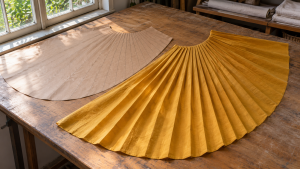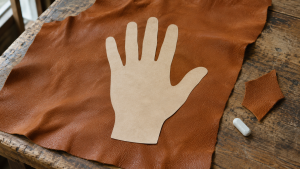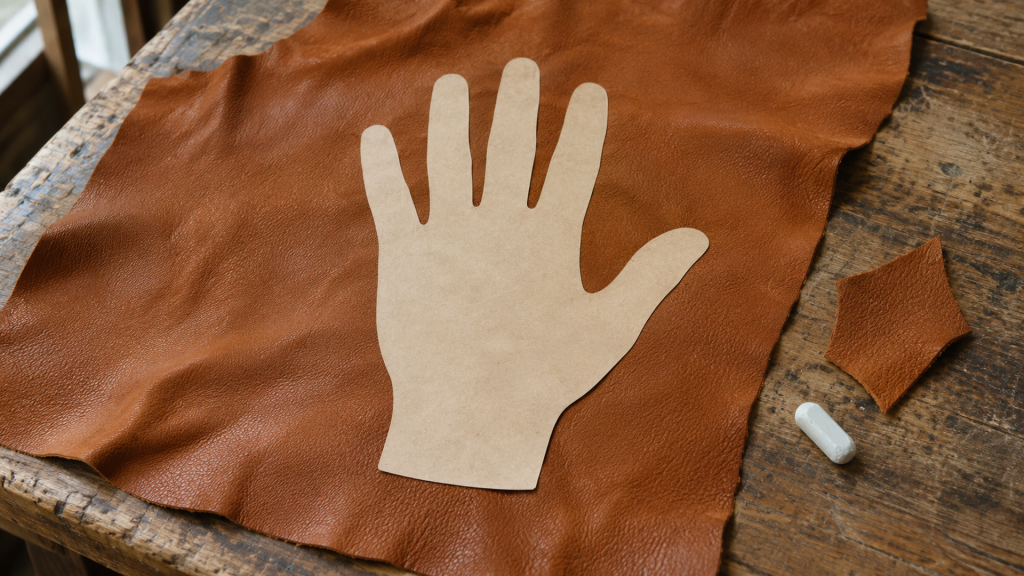
A paper palm makes the orientation of a glove-leather layout visible. AI-generated image.
A glove cutter turns the paper palm until the leather’s easiest stretch runs across the hand. Spread your fingers a little and look at the space from the base of the index finger to the base of the little finger. That is the span the leather needs to accommodate. Turn the pattern a quarter turn and the same give now points towards the fingertips. The outline on the bench looks just as convincing either way.
The featured illustration shows a teaching outline on glove leather. AI-generated image.
Find the direction in a piece of leather
Watson Gloves shows the decision near the beginning of its tour of the cutting room. Look at the second photograph in the cutting section. The maker identifies the horizontal stretch as the one wanted for fit and explains what happens if the stretch goes up the fingers instead. The reference is the hand going into the glove. A cutter could walk around the bench and see the photograph upside down. The give still needs to cross the knuckles.
To try the idea, ask a maker for a small offcut of glove leather you can mark. Find out whether it has already been stretched or otherwise prepared for cutting. A stiff piece left over from a belt answers a different question. On the scrap, choose a patch well away from any thin ragged edge. Take a light grip at opposite edges of the patch and ease the two points apart. Release them. Turn the scrap a quarter turn and try again over about the same distance with the same light pull.
Mark the easier direction with a long chalk arrow. Draw a shorter arrow across it at a right angle for the other trial. The marks describe which pull gave more readily. Their lengths are a convention for this drawing. They say nothing about how many centimetres the hide stretched. If the difference is hard to feel, take the piece back to the cutter and ask where on this particular offcut it is easiest to compare.
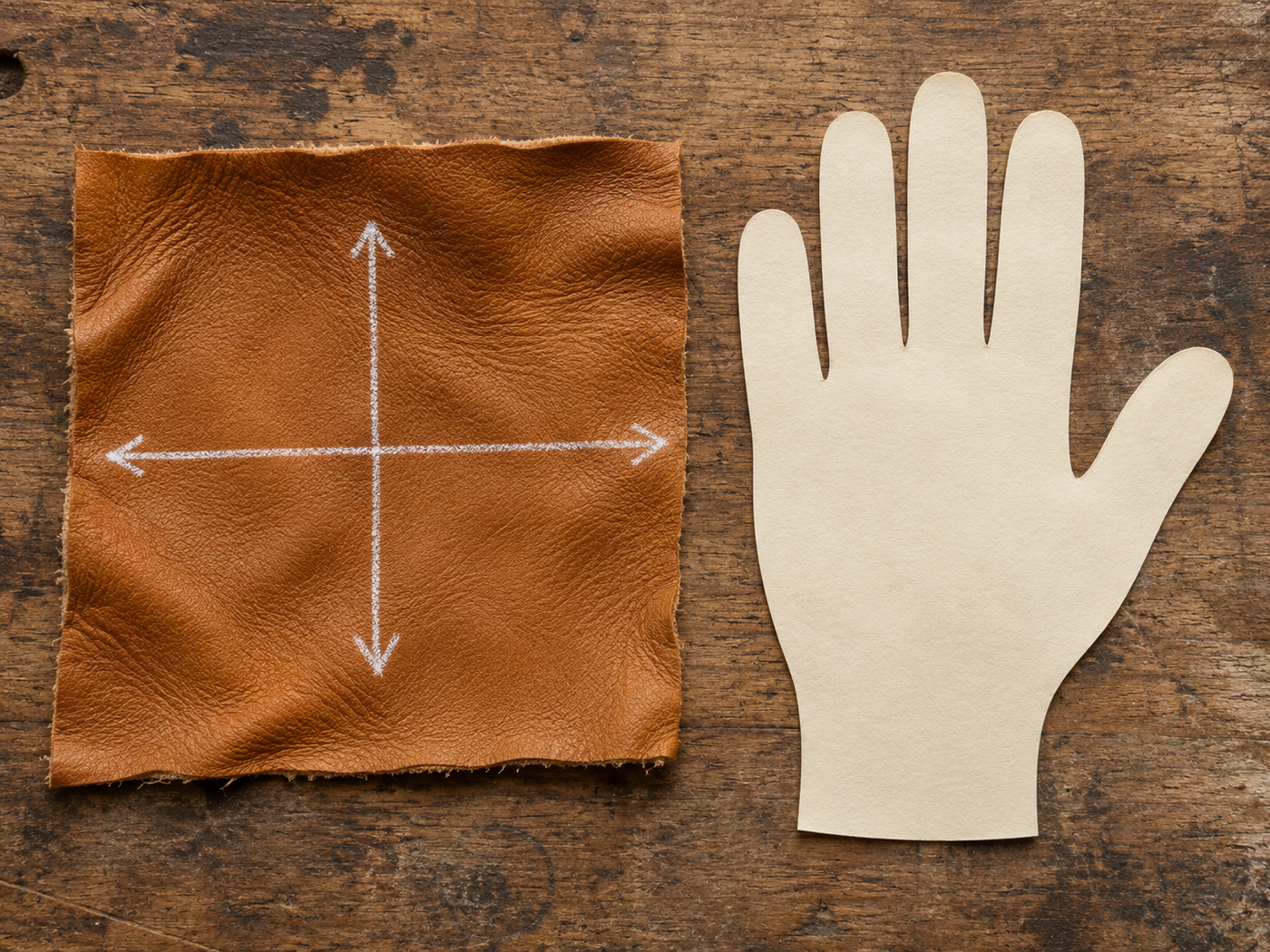
Turn the paper and leave the arrows still
Trace around a relaxed hand on paper. Cut out the tracing and draw one line across the bases of its four fingers. That is your reference edge. Set the tracing beside the scrap so that the line lies parallel to the longer arrow. Slide the palm over the patch, leaving enough arrow visible on either side to see where the give would go. Think of the moment when the broad part of your hand has to pass into the glove.
Now swing the paper through a quarter turn while the leather stays put. The arrow emerges at the wrist and points up the hand. Spreading your fingers would ask the less yielding direction to go around the knuckles. You could draw and cut exactly the same palm shape in both positions. It is only when someone tries to get a hand inside that the two pieces are asked to do different work.
A report prepared in St. John’s in March 1953 gives this choice a second reference point. The process chapter of the Newfoundland Department of Economic Development’s report on glove making follows the preparation of the skin before the pieces are cut. It puts the width of the skin around the hand. Set your traced palm beside that description and you can read the direction without having to reconstruct an entire glove from a factory drawing.
Keep one corner of the offcut
The paper exercise isolates one decision. Your traced fingertips have no thickness. A real hand does, and a glove has seams and a thumb opening that the tracing cannot test. If the width is uncomfortable in a finished pair, you would need to examine the glove before assigning the cause to the cut. For a conversation about an uncut palm, the two crossed arrows are enough to point to the decision that has to come first.
If you keep samples, fasten this one at a single edge so both directions remain easy to try. Write down the maker’s description of the leather and how it was prepared. A set of labelled handling samples lets another reader repeat the comparison even after the chalk rubs away. Leave the paper hand with the scrap. Ask the next person to turn it into position, then lay their own open palm over it and show you where the longer arrow comes out.