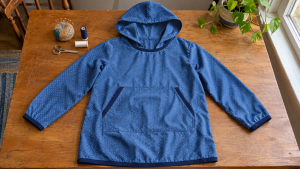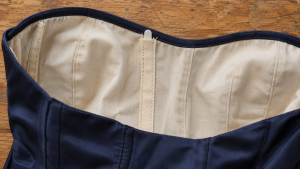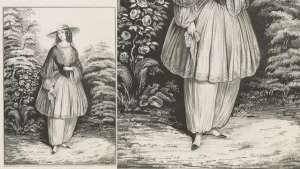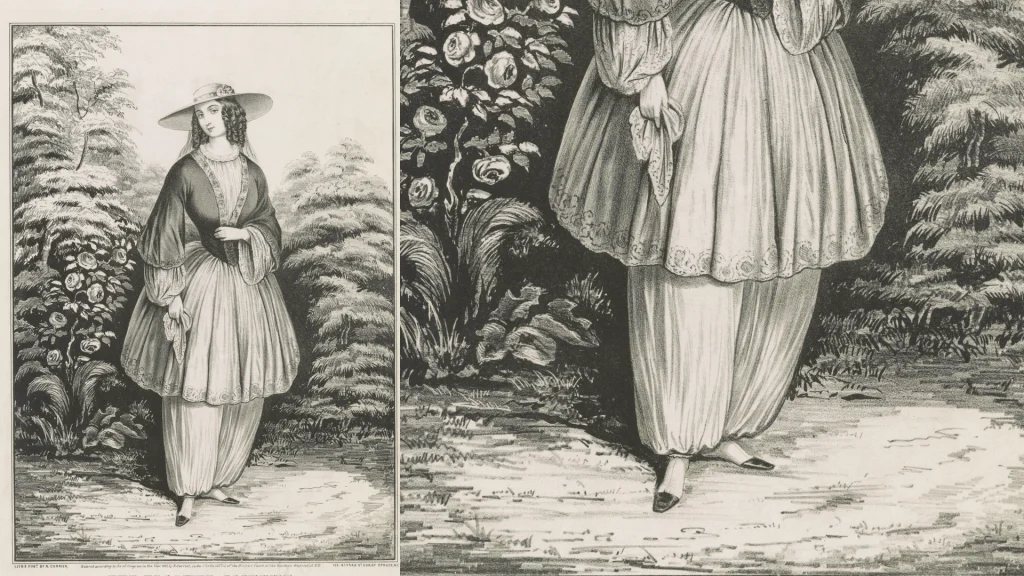
Full figure and clothing detail from The Bloomer Costume, 1851. The sitter is unnamed in the catalogue. Prints and Photographs Division, Library of Congress, PGA 06193. Public domain.
Amelia Bloomer remembered the black satin. In her account of dress reform in Seneca Falls, it was Elizabeth Cady Stanton who walked out in a short skirt and trousers of that material. Stanton had seen the style on her cousin Elizabeth Smith Miller. Bloomer took it up herself and told the readers of her newspaper. Three women could wear the clothes on the same village streets. Only one had her surname travelling with the story each time another editor picked it up.
Featured print and detail. The Bloomer Costume, 1851. Prints and Photographs Division, Library of Congress, PGA 06193. Public domain.
Bloomer’s recollection appeared in the 1895 volume her husband Dexter put together after her death. It preserves a distinction she cared enough to make years afterwards. She credited Miller with bringing the outfit into their circle and said she never learned who had first attached the name Bloomer to it. That is a surprisingly precise limit to what one of the best-placed witnesses could tell us.
A page from April
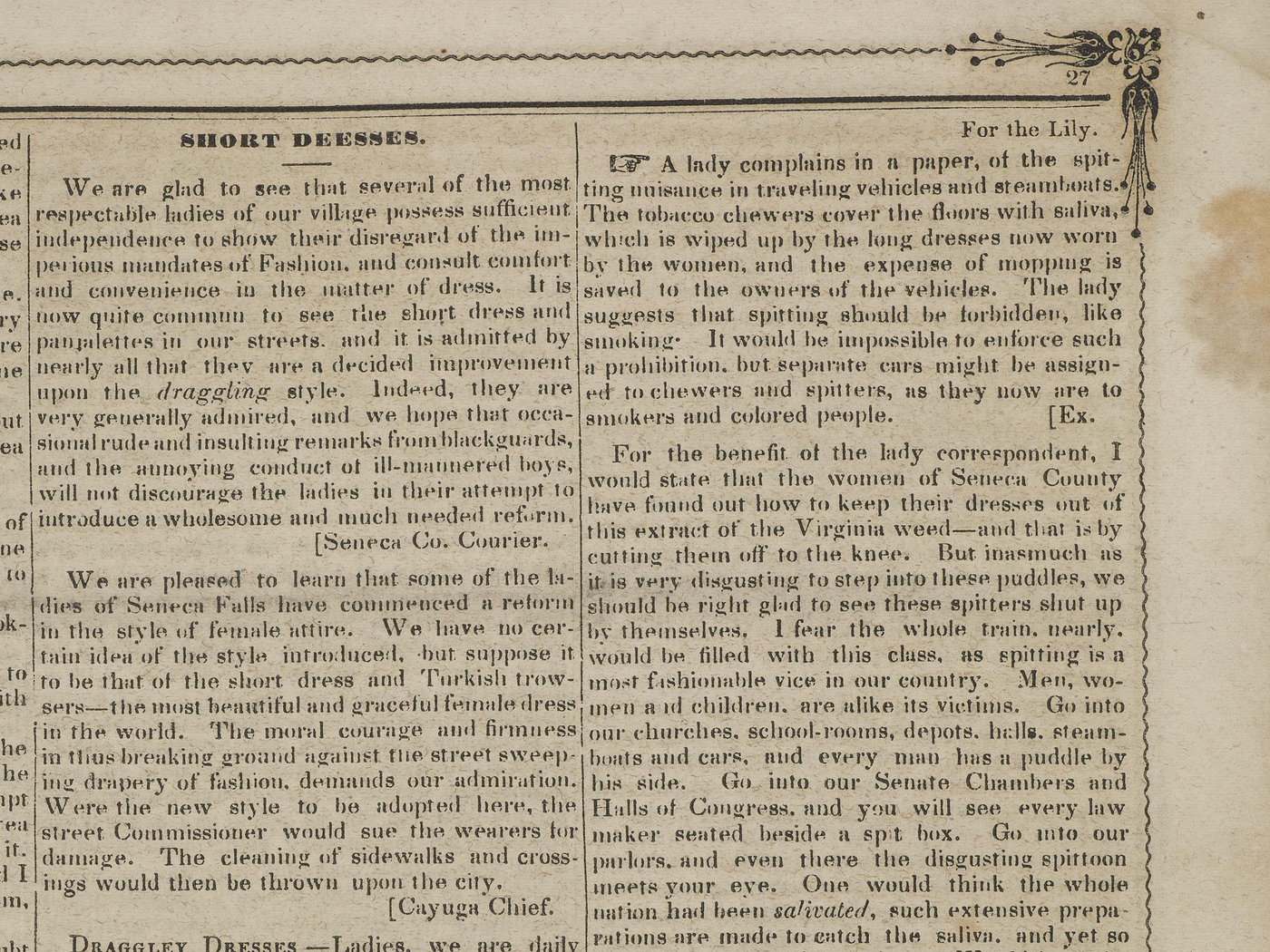
The contemporary paper puts a date under one part of the memory. On page 27 of its April 1851 issue, The Lily carried a piece headed “Short Dresses.” It gathered comments from other newspapers. A reader outside Seneca Falls could therefore encounter an argument already in progress, with more than one editor’s voice on the page. The issue establishes that the shorter dress was being discussed in print that April. It gives much less help with the order in which three neighbours first put theirs on.
Look closely at what was shortened. The skirt still went over the trousers. In an 1851 print held by the Library of Congress, the hem cuts across the fullness of the legs below it. Fabric is gathered again near the wearer’s ankles. A viewer could recognise the outline from across a street. The print bears the title The Bloomer Costume. It supplies evidence for the name in circulation that year. Its pictured figure carries no identification that would let us call her Miller, Stanton or Bloomer.
Who brought it through the door
In Bloomer’s telling, Miller had worn the short dress for some time before visiting Stanton. Stanton’s adoption made the outfit visible on another local wearer. Bloomer described joining in after she had already written about the practical objections to a long skirt. Her change of clothes gave a reader something particular to ask about. A letter could now go to the editor who had tried the style herself.
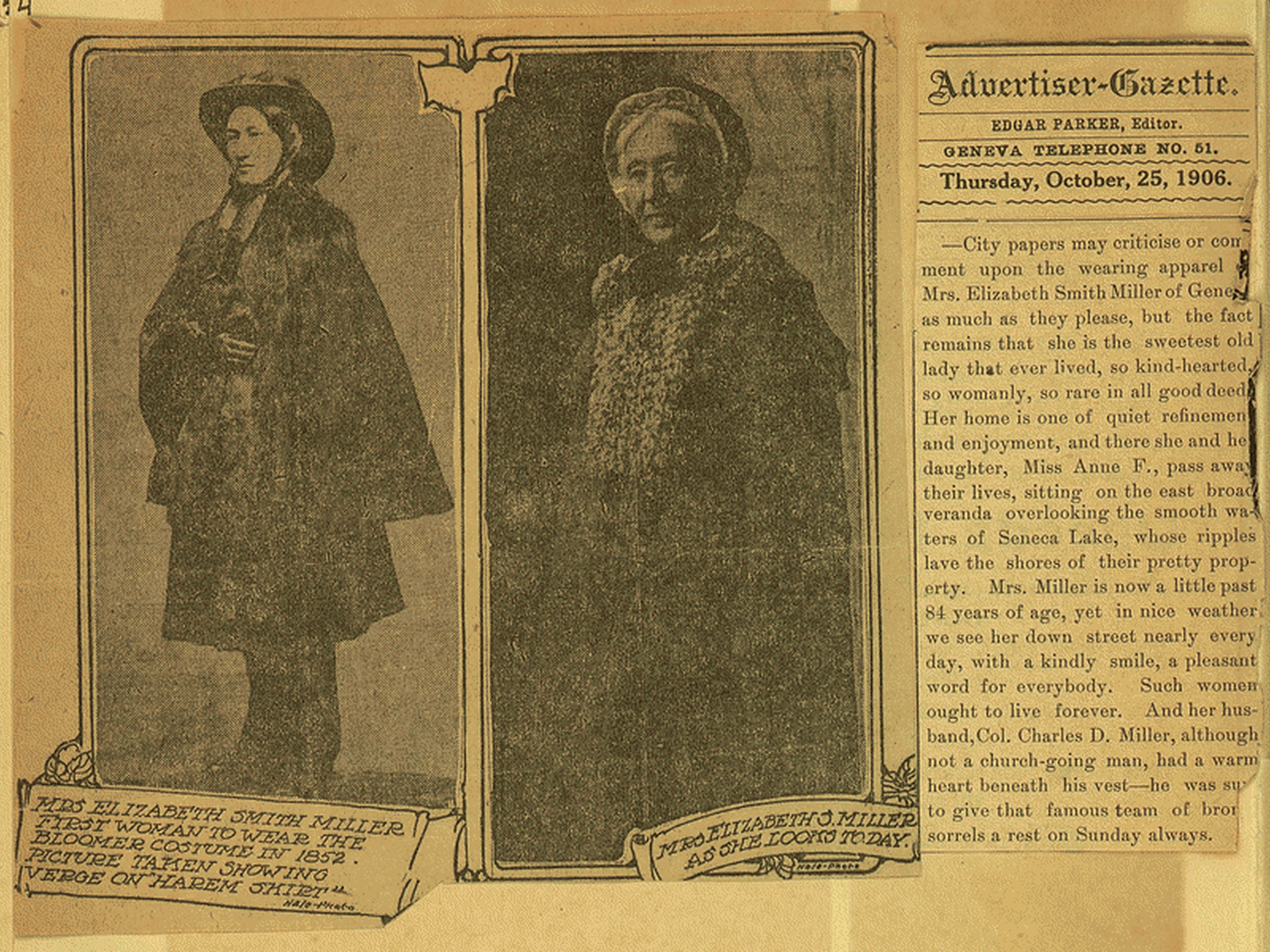
The Library of Congress also holds a later newspaper clipping that identifies Miller. It pairs a view identified as her in the costume in 1852 with one of her in old age. The clipping belongs to a much later scrapbook. Read the dates separately. One concerns the clothes the earlier likeness represents. The other belongs to the newspaper looking back on a woman whose life extended well beyond that outfit.
How a name leaves town
Bloomer recalled letters asking for patterns. She also remembered other editors reprinting the news, sometimes with a joke at her expense. The name on the paper was convenient for people addressing either sort of response. A reader wanting to make a pair of trousers and a columnist wanting a short headline had quite different reasons to keep using it. You can see how an editor’s surname could travel farther than the fuller account of Miller’s visit.
If you’re tracing when a style reached one town, give the dated newspaper item and the later recollection their own entries. A reprint can tell you that readers saw an idea there by a given day. A letter, photograph or identified account of wearing it can tell you something else about adoption. The same distinction comes up when reading dress through a named speaker’s memory. A vivid detail can belong to a witness even where the precise day has slipped away.
Keep all three names beside the 1851 print. Put Miller beside the visit, Stanton beside the black satin, and Bloomer beside the paper in which she could speak directly to her readers. The familiar name on the sheet then becomes a piece of evidence in its own right. It tells you something about the reach of a publisher.