Put the completed garments beside the accepted count before dividing the cost sheet. Identify what the workshop spent once for the run, what it paid for each operation, and which pieces it can deliver at the stated quality. The unit figure is the total within your chosen boundary divided by the accepted units within that same boundary. A single rejected apron can change that figure even when every invoice stays exactly as it was.
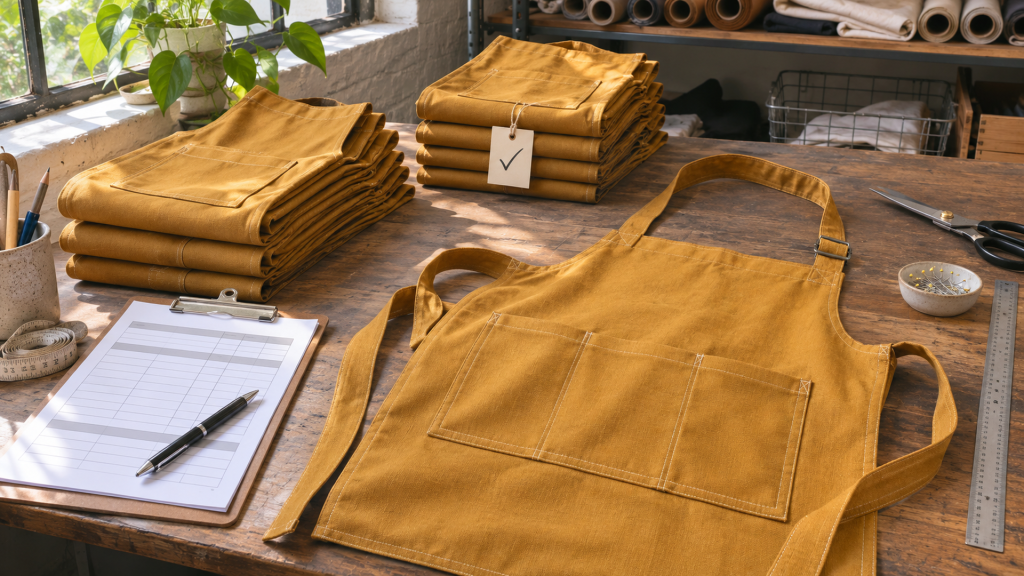
Featured image generated with AI. The aprons and cost figures form a fictional workshop exercise.
Here is a fictional workroom example in U.S. dollars, set in a small U.S. shop for one production week in May. The maker planned 24 ochre canvas aprons. Each needs a patch pocket, and the workshop has a separate operation for stitching it in place. The illustration and figures are teaching materials. They give you a complete calculation to take apart before asking another workshop to share any of its own invoices.
Name the figure the sheet is meant to produce
Write a question at the top. In the apron example it is “What did the included workshop work cost per accepted apron for this run?” That identifies both the unit and the boundary. A quotation for making future aprons, a retail price on a rail and the cash remaining after a sale answer other questions. Two well-kept sheets can produce different results simply because one includes delivery or selling costs and the other stops at the finishing table.
Put the style, version, location, currency, period and quantity originally planned next to the question. Note whether the order covers one fabric and colour or several. A shop that set up one jig for two colours may want to share a cost between them. A second colour that required its own set of trials may deserve a separate setup entry. Ask what work the invoice actually covered before allocating a neat half to each colour.
A cost sheet can also mix estimates with amounts actually charged. Give those entries different marks or columns. A quotation for 24 aprons is a useful record of the original plan after only 23 pass inspection. Keep both versions and label the decision each supported. Replacing the quotation with the final result would hide why the maker originally thought a particular quantity or price was workable.
Place the first invoice against the planned run
In the fictional shop, the pattern and pocket setup costs $120 for this run. Read the invoice for what that work bought. It might include making a template and setting its position on the front. If the agreement applies that charge once to the 24-piece run, the planned share is $120 divided by 24, or $5 per apron. Keep the $120 on the sheet as the actual amount owed and $5 as a calculated allocation.
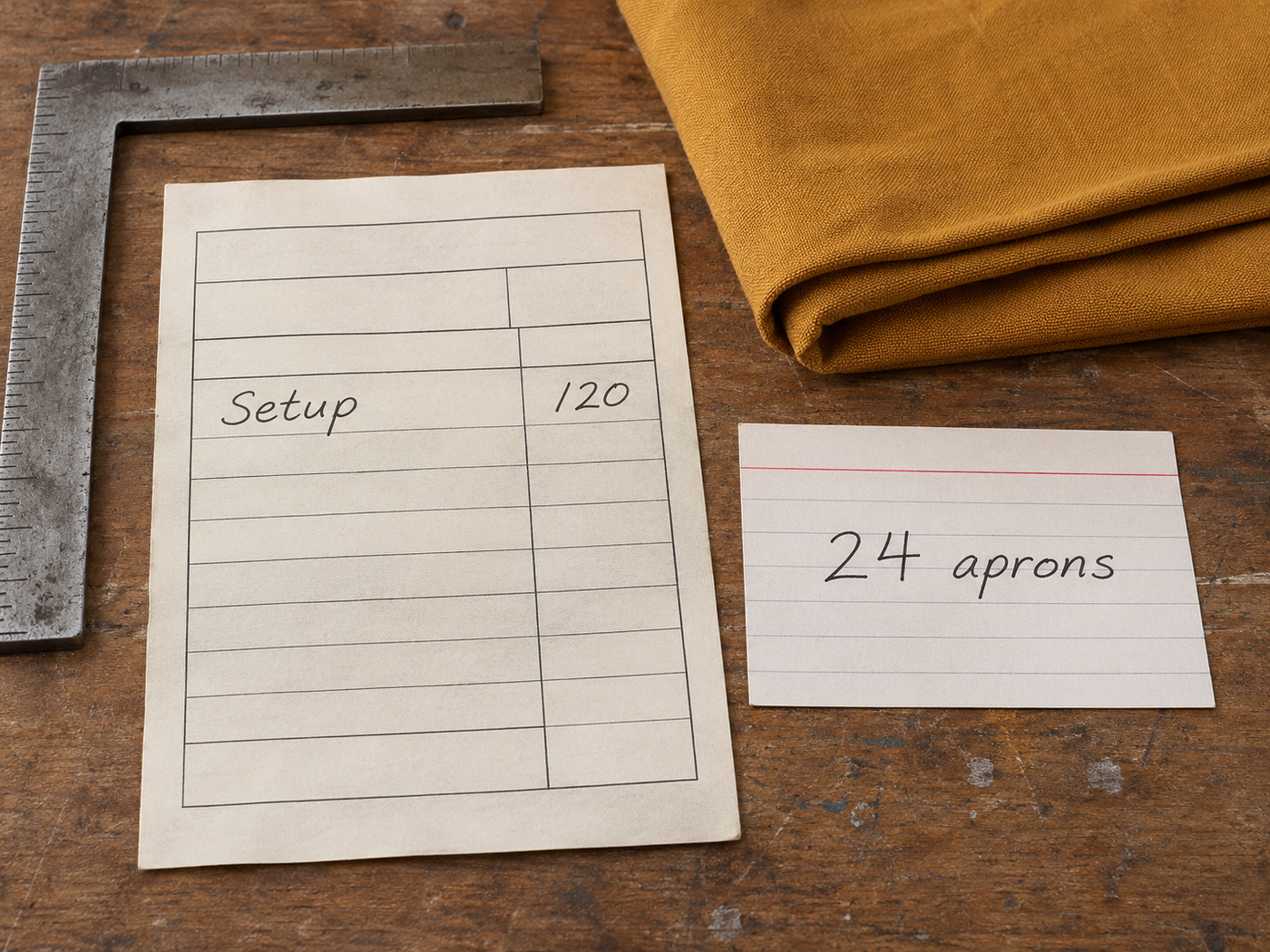
Ask whether the setup could be used again and how the shop treats it if there is a repeat order. A maker might bill for fresh setup each time, or treat an existing template as work already paid for. Record the arrangement for the actual run. Spreading today’s cost over an imagined future order would bring units into the denominator before anyone has agreed to make them. Likewise, charging a repeat the whole historical setup again needs some explanation.
The International Trade Centre’s Garment Costing Guide examines overhead allocation and the difference between types of costs in a production setting. The way a particular shop includes overhead belongs in your notes. If the operator’s hourly rate already includes part of the workshop overhead, adding that amount again as a separate allowance can double-count it. If rent is entirely outside the sheet handed to you, identify that boundary instead of estimating a share on the shop’s behalf.
Follow one pocket past the machine
Place a finished pocket beside the operation ticket. Where does this job begin and end? Folding a pocket top, marking its position, attaching it and checking it could be paid as one bundled operation or recorded separately. Read the shop’s wording. In the practice run the per-piece charge covers attaching an already prepared pocket. The ticket records 24 completed attachments at $2 each, making $48 for this line.
An operation count is attached to the work performed. The garment count at final inspection can be lower. If a strap later fails inspection, the pocket on that apron may still have been correctly attached and credited under the agreement. Deleting the pocket charge merely to make every column say 23 would lose work the shop actually paid for. Ask which stage accepted the pocket and which stage accepted the complete apron.
If a worker was paid by a bundle or a dozen, make the conversion visible. Twelve pairs of ties correspond to a different number of finished aprons from twelve individual ties. A piece ticket belongs to one worker or group and one operation. The separate guide to matching a garment worker’s piece ticket to a pay entry explains that level of detail if the operation charge itself is the part that needs checking.
Build the numerator without counting a line twice
Here is the complete practice sheet. Keep the run-level charges in the dollars column until you have reconciled them.
| Workshop entry | Basis | Amount in U.S. dollars |
|---|---|---|
| Pattern and pocket setup | Once for this run | $120 |
| Canvas | Material issued to this run | $192 |
| Pocket attachments | 24 at $2 each | $48 |
| Other workshop operations | Cutting, sewing and finishing, with pocket attachment already removed | $120 |
| Total charge within this boundary | Before division by accepted pieces | $480 |
This workshop subtotal covers the listed operations. Packing, outbound freight, retail selling costs, tax and a separate overhead allocation fall outside the exercise.
Read the canvas entry against its issue and return paperwork. Cloth bought on a full roll may serve more than one job. An invoice for the whole roll cannot by itself establish how much cloth this run consumed or how the shop values what came back. If that is the uncertain line, balance the roll issue against cut pieces and returned remnants before translating area into an amount on the cost sheet.
Next check whether the amounts share one currency, period and basis. A supplier’s price per metre belongs beside the metres the shop was charged for, with any agreed allowances recorded separately. A figure recorded before a supplier credit can change once the credit is actually issued. Give a later credit its date and reference. A possible recovery for selling a second-quality apron is likewise an open item until the shop knows what it received.
Change the accepted count and watch the result
With 24 accepted aprons, $480 divided by 24 gives $20.00 each. Suppose the last apron has a pocket seam the inspector rejects and the piece cannot be delivered in this run. All the included charges have already been incurred. With 23 accepted aprons, the same $480 divided by 23 gives $20.87 per accepted apron, rounded to cents. Retain the full precision until the last step if the figures go back into another calculation.
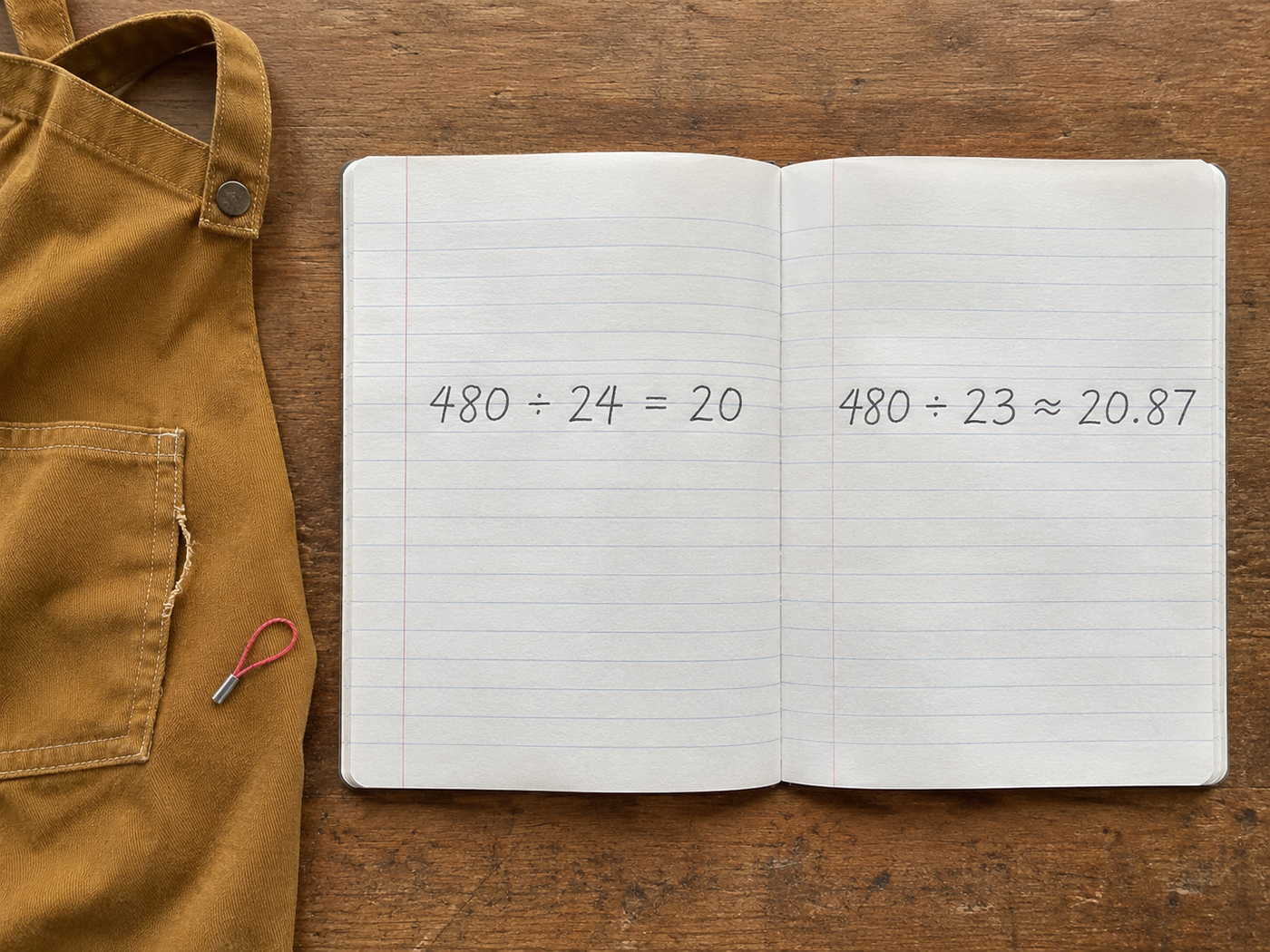
The one rejected unit raised the reported unit cost by about 87 cents. That difference is spread across the accepted output. It is not a new $0.87 invoice from the workshop. The share of setup alone moved from $5 to about $5.22. Those rounded shares need not multiply back to the total exactly. Preserve the original $120 and $480 so the invoice and run can always be reconciled without accumulating rounding errors.
Change the fate of the rejected apron and the conversation changes again. If the workshop can rework it for another $8 within the same run, and it then passes, the numerator becomes $488 and the accepted count returns to 24. That produces about $20.33 per accepted apron. A repair simply proposed by the inspector has no place in a column labelled actual. Keep that result as a scenario until there is both a charge and an acceptance record.
Hand the figure back with its boundaries attached
Read the result aloud as a sentence. For this one U.S. workshop exercise in May, $480 in specified setup, canvas and workshop operations produced 23 accepted aprons, or $20.87 per accepted piece. The excluded selling and delivery costs remain visible in the note. Anyone comparing that result with another maker’s quotation can now ask whether the same operations, currency, quality threshold and accepted count sit behind the other figure.
Keep a copy of the accepted-count sheet, the setup entry and the operation ticket with the final calculation. If the maker shared sensitive figures, agree on the scope of any public use and remove identifiers as agreed before reproducing them. A teaching example can use invented numbers. A real invoice belongs to the business and the people whose labour it records. The reader ought to be able to tell which kind of calculation they are holding.
When a late rework, supplier credit or second-quality sale changes the result, add a dated revision. Write down which amount or count changed and leave the earlier version available to read. The next person can start with the 23 finished aprons on the table, find the missing twenty-fourth, and say exactly how its fate reached the figure at the bottom of the sheet.

By Alma Quillan