
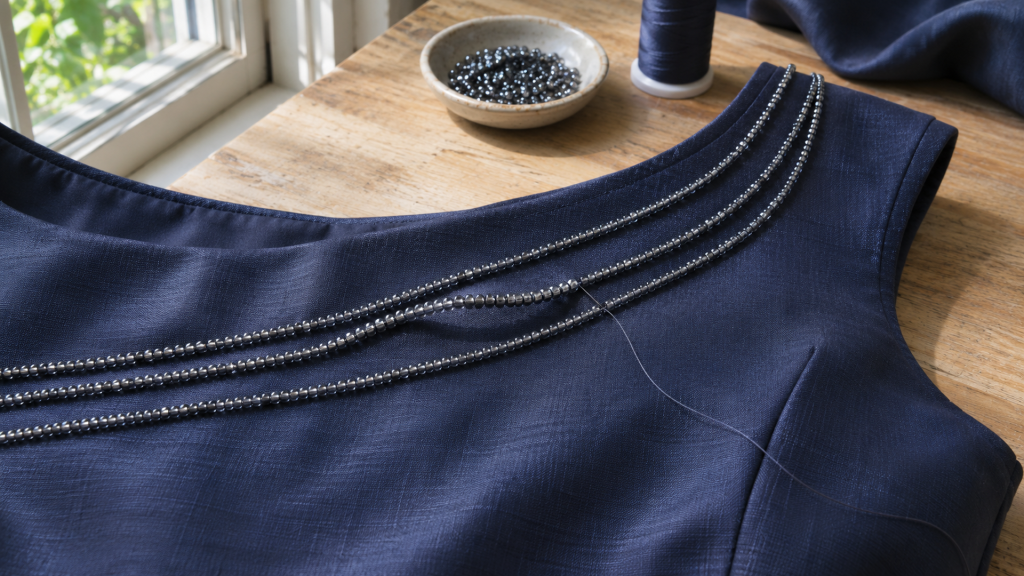
A short lift interrupts one line while the neighbouring rows stay close to the cloth. AI-generated image.
One row of beads stands away from the bodice. The row above still follows the cloth when you lay the dress down. That difference gives a beadworker a place to start looking. The length to secure depends on where sound attachment resumes on either side of the lift. Counting the beads in the air won’t tell you where those points are.
Featured image generated with AI.
Give the dress a broad, clean surface and let the weight of the skirt rest there too. If a bead has already fallen clear, put it in a little lidded container and keep it with the dress. A single original can answer several questions about colour and size. Leave the beads still on the thread exactly where you found them.
Make a map the dress can survive
Start far enough back to get the whole bodice in one photograph. Include a fixed landmark such as a dart, the top of the side seam or the neckline. A close-up of three shining rows is remarkably hard to place once the dress is back in its bag. Turn the light across the cloth so the small shadow under the lifting row shows. Move the lamp or your phone to get that view. The strand can stay still.
Take a closer picture of each end of the lift. On a copy of the picture, mark where the first bead appears to leave the ground cloth and where the row seems to settle again. A neighbouring row gives you a reference for the spacing. Note any bare stretch of thread as a separate observation. A gap might mean a missing bead. It might also mean that the beads have slid together farther along the line. Keep both possibilities open.
Two threads can have different jobs
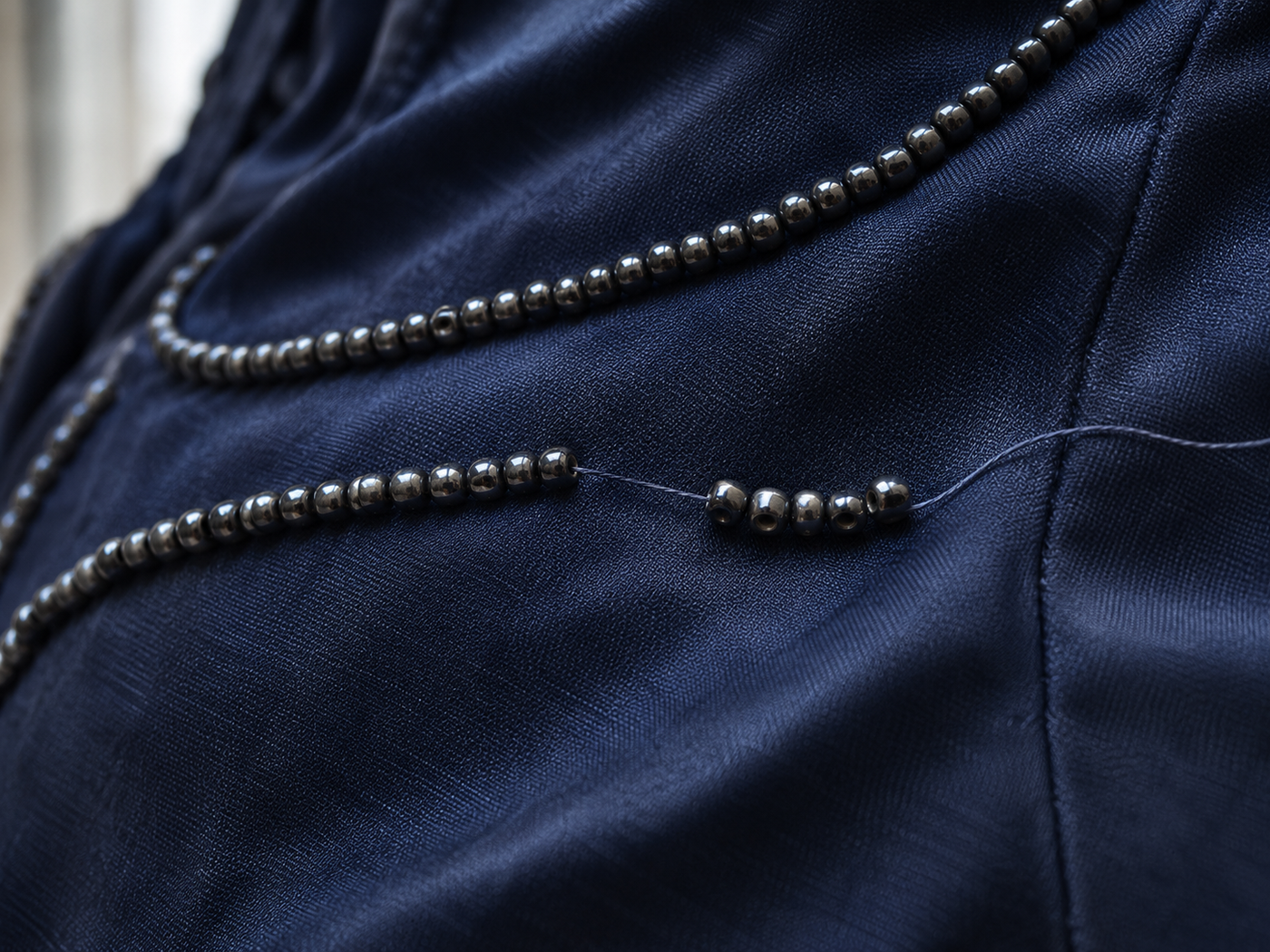
One way to sew a line of beads is to string them first, lay the string against the cloth, then catch it down at intervals with another thread. A broken catch lets a little bridge of beads rise while the string through their holes still holds. The McCord Stewart Museum’s conservator illustrates that method of spot stitching on specific bandolier bags in its collection. Your evening bodice may have been made quite differently. The example gives you a precise question for the fitting. Which thread can the beadworker actually see?
Ask the beadworker to point out the last attachments they can identify on the photograph. On a scrap of similar cloth they can run a contrasting thread through a few spare beads to show the path they propose to follow. If you’re comparing two sample rows, mark which end of each sample is which before you turn them over. The line that looks closest in daylight may be the one that sits less comfortably around the curve.
Agree where the work stops
The reverse side matters. A lining may cover the place the beadworker needs to reach. Ask them to show you where they could get access and how they would close that opening again. If access would involve a seam you had expected to leave alone, get that written into the estimate. You can approve an inspection first and decide on the repair once the specialist has seen the back.
Put the original loose bead beside any proposed replacement on the same colour cloth. Look at the pair by a window, then under the light in which you expect to wear the dress. A bead can match head-on and still flash a different colour when the row turns. Size matters in the row too. A handful of slightly longer beads can carry the line past the point where it used to end.
Your note to the beadworker can be quite short. Identify the row by its landmark, attach the marked picture, and say whether matching beads, opening the lining and closing it again are included. Agree on a stopping point if another stretch of weak attachment appears. When the dress comes back, put it beside the first photograph. You’ll be able to find the repaired line, see where it rejoins the original work and account for the beads that came home in the little box.

1 thought on “Mapping a Loose Bead Strand on an Evening Bodice”