A laundry account tells you which garments or services someone chose to record for a particular exchange. Start by transcribing one line exactly as written, including its quantity, unit and marks. Then compare it with another entry in the same hand and a price list from the same place and period. You may end with a convincing account of six collars being washed while the identity of the person who wore them remains open.
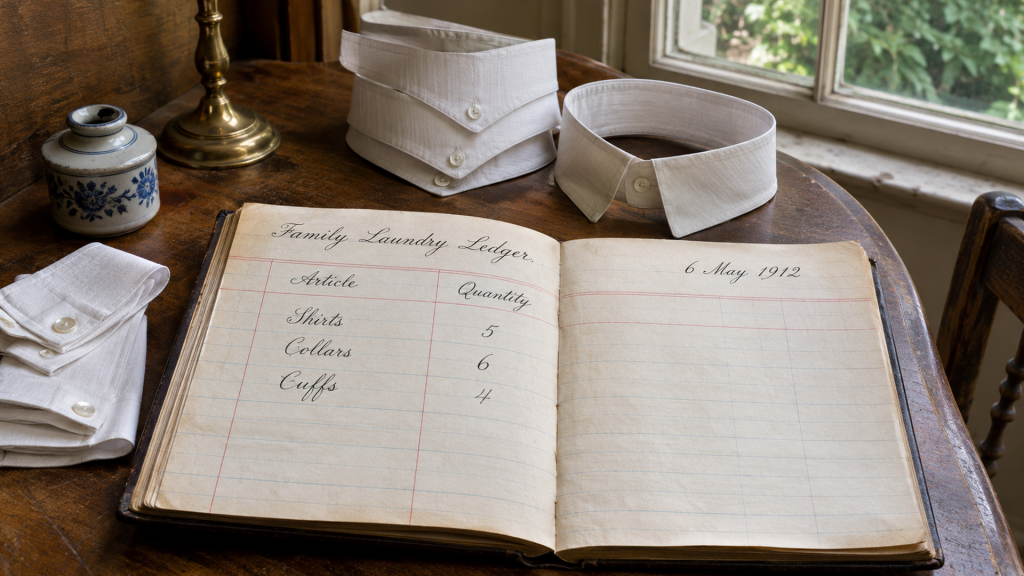
Featured image generated with AI. The household account in the illustration is an invented example.
Lay the bill flat in its original order and look first for the words that mark a transaction. Sent, received, returned, carried and paid describe different moments in the life of the same shirts. If the account belongs to a family, preserve the name that family gave the book as well as the title printed on its cover. A descendant’s description can tell you how it was kept without settling who made every entry inside.
Establish whose week and which date you can see
Record the business, customer or household heading, location, currency and period wherever the bill supplies them. Copy an address just as it appeared, including the town if present. Separate a week ending date from the day the account was paid. A form stamped in March can include a charge carried forward from February. If the date appears only on an envelope, make that connection explicit when you describe the bill.
On a weekly ledger, check the facing page and the entry above the one that interests you. A single written date can govern a group of lines. The next change of date may appear farther down the sheet. An account for a boarding house, hotel or shared household might use one customer name for the whole delivery. That name establishes an account holder more readily than a wearer. Give the delivery and any known individuals separate entries.
Photograph or copy the entire page before enlarging the faint line. Include its edges, headings, column rules, page number and anything on the reverse. A pencil tick can refer to a column heading out of view in a tight crop. Make a note of folded areas or missing corners. If a question turns on a crease you cannot safely open, record what the surviving view shows and ask the collection holder about another image.
Follow one repeated word through the handwriting
Start with a term that recurs, such as collars. Copy the spelling, capitalisation and any abbreviation as closely as you can. Compare the beginning of the word with another clear example by the same writer and the ending with the letter shapes elsewhere on the page. A beautifully legible word on a printed price list may suggest a reading. It cannot establish how this particular hand formed a doubtful letter.
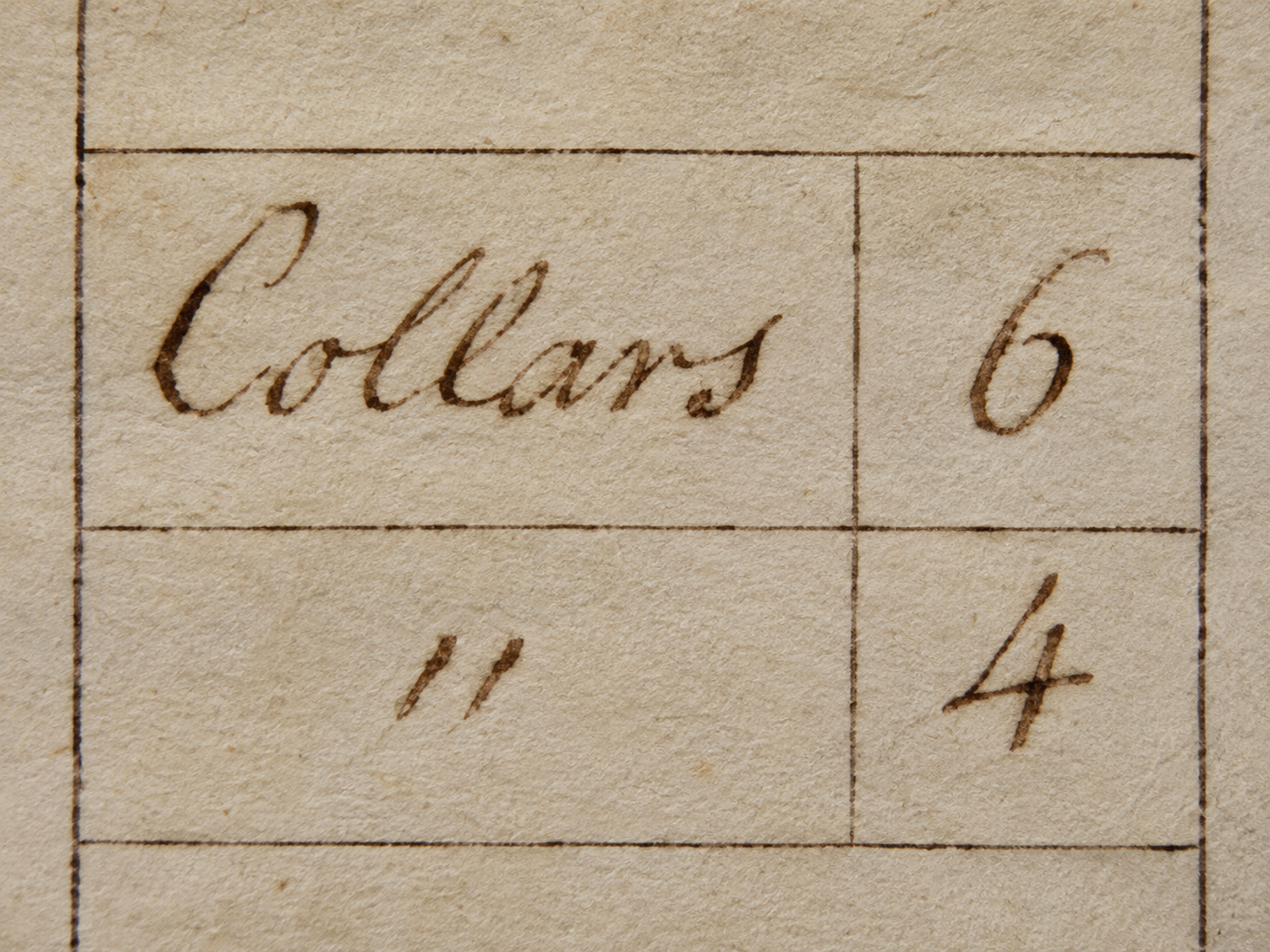
Look straight up from a ditto mark in its own column. On a ruled form a repeated garment name and a repeated price can sit only a short distance apart. The mark might carry the garment down to a new quantity while the price column contains its own figure. If the page has no rules, follow the alignment across several rows. Make a note of any place where the writer changes their convention rather than treating every pair of strokes as the same instruction.
In a fictional account dated May 6, 1912, the first line of a practice extract reads “Collars 6.” The line below has a ditto in the garment column and a 4 in the quantity column. You can transcribe the second entry as a ditto and give “collars” as its expansion in a parallel reading. Ten collars is a possible subtotal only after you establish that both rows record separate receipts or charges. Six sent and four returned describe different stages of the same work.
Decide what counted as one item
A collar might enter the list on its own or as part of a shirt with its collar attached. Cuffs might be priced singly, by the pair or as part of another garment. Search for the unit attached to the service on this bill. Descriptions that make perfect sense to the people exchanging the washing often look frustratingly incomplete a century later. Preserve a separate line for each category until the account gives you a reason to combine them.
A price list can make the distinction visible. A surviving Imperial Laundry form from C. W. Bright & Bros. in St. Louis, preserved in the Missouri State Archives, lists plain shirts, shirts with collars and cuffs attached, and collars charged individually. The form bears a March 1900 date stamp. It documents how one business divided its work. It does not set the tariff for an unnamed laundry operating in another town twelve years later.
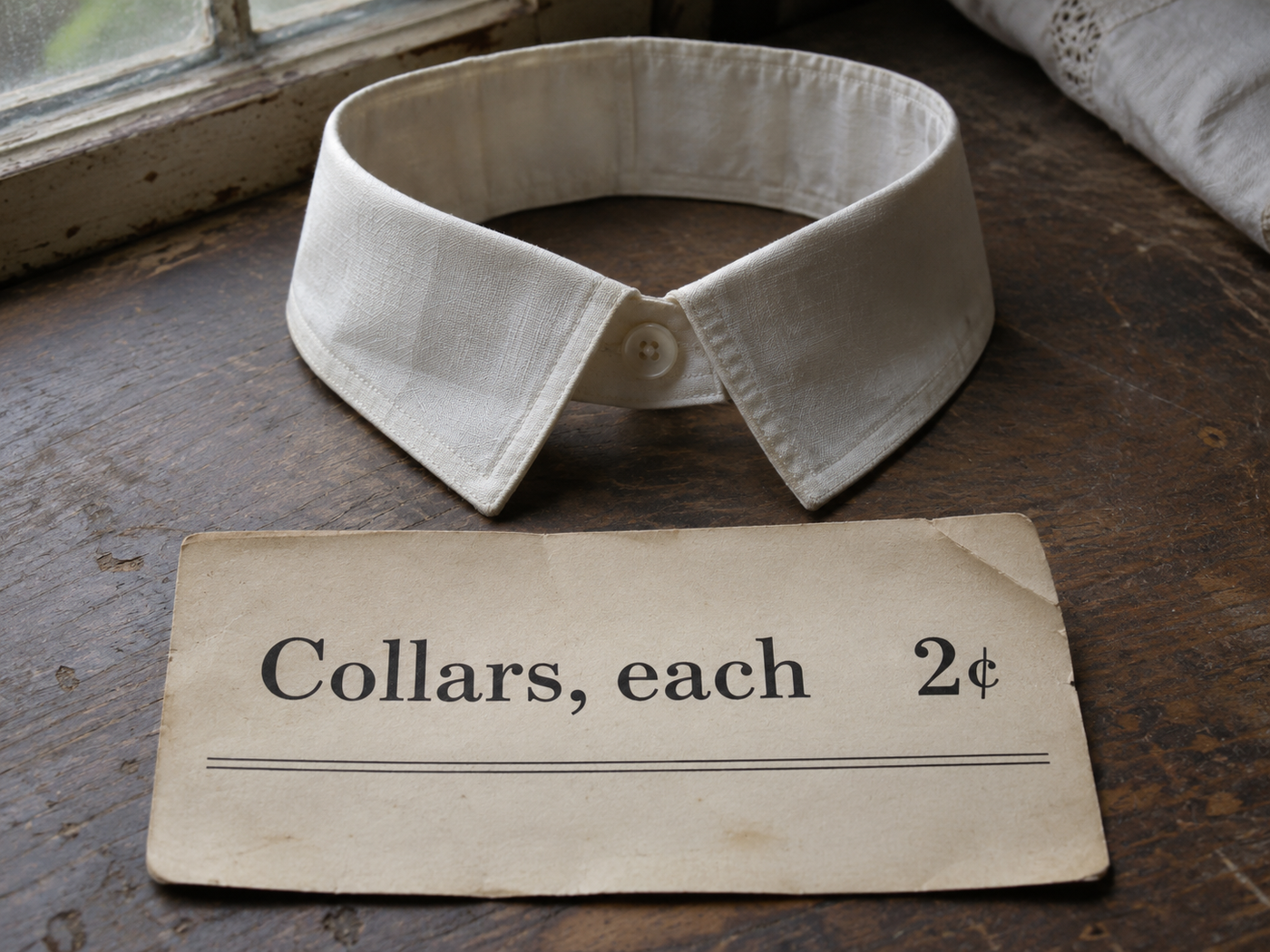
Match the city, business name, date and service description before using a list to check a sum. Note whether the charge covered washing, ironing, starching, a repair or a bundle charged by weight. A line bearing an item name on a laundry list is generally a better comparison than the same garment advertised for sale in a store window. One price pays for work on an existing object. The other may buy the garment itself.
For the practice card, suppose the relevant laundry charged two cents per detached collar and the six collars belong to one service line. Six at two cents gives twelve cents. If the next figure looks like twelve, the arithmetic supports your reading. Another count and rate could give the same sum, so keep the handwriting evidence and the price comparison alongside the arithmetic. This two-cent example is invented and distinct from the St. Louis form’s charge of two and a half cents each.
Make uncertainty legible on the transcript
Keep a first column close to the document and a second for expanded readings. If a garment term ends in a mark you cannot identify, bracket that uncertainty and describe where it falls. Avoid silently expanding the word to the garment you would like to find. A plain notation such as “[unclear]” gives the next reader permission to see something different. If you know the first three letters, preserve them too.
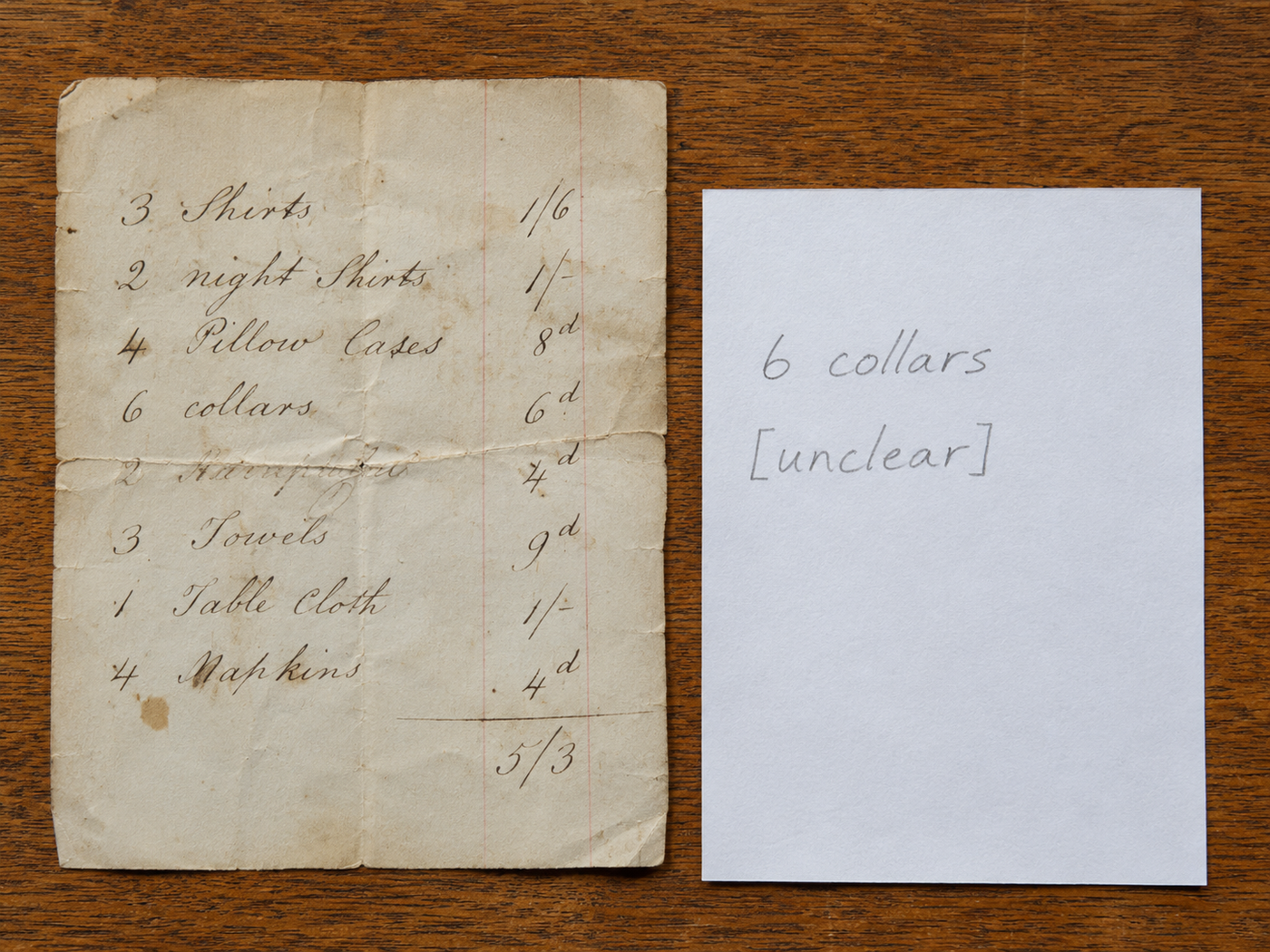
Compare a second week in the same hand. Perhaps the writer supplies the term in full there, or uses a distinctive loop for the quantity four. If another person signed the later week, treat that change of hand as a fact worth keeping. A second document can corroborate local vocabulary without solving the shape of a letter in the first. Write a short note saying exactly what prompted a revised reading and identify the comparison entry.
If someone remembers a family expression for a detachable collar, ask where they heard it and whether they remember this particular laundry. With permission, save the words and the date of the recollection. Use the speaker and time reference for a garment term when the memory comes from a recording. A shopkeeper’s term, a family nickname and the printed tariff may all refer to a related object while doing different work in the record.
Reconcile the money on the page
Read each column heading before adding the figures. A subtotal may already include the lines immediately above it. A payment may reduce a balance due while leaving the list of services untouched. Draw a light line on your working copy between current work, earlier balance and money received. Where the currency symbol is absent, look for it elsewhere in the same book or leave it unconfirmed. A decimal point alone cannot distinguish U.S. from Canadian dollars.
When the sums disagree, work back to the unit before assuming a mistake. Two pairs of cuffs charged by the pair and four individual cuffs recorded at the bundle counter can describe the same physical delivery. If the descriptions and rate agree but the total still differs, leave the discrepancy intact. An undocumented discount, omitted service or later adjustment remains a possible question until another line accounts for it.
Describe the work without assigning the wardrobe
For the imaginary six-collar entry, you can now identify an account term, a quantity, the assumed unit in the exercise and a charge that reconciles at twelve cents. You cannot determine whether one person owned all six collars, whether six people sent one apiece or whether the garments were ever worn together. A photograph showing a relative in a detached collar can establish a resemblance. It cannot assign the six items on this bill to that relative.
End the transcription with the bill’s identifier, its date and place as far as known, the two or three lines you can defend, and any word still open. Locate the price list and the comparison bill precisely enough for a second reader to retrieve them. If the next document to arrive is a worker’s record of pay per completed operation, follow the quantity credited for one piecework operation before relating those earnings to the laundry’s customer charge. The account you have already reconstructed stands on its own as a record of work that changed hands.

By Nell Aster