Read one claim and find its parts in the drawing. The whole dress gives the invention somewhere to work. The claim tells you which arrangement the applicant asked the patent office to recognise. To say that a dress with that arrangement reached a shop or a wearer, look for a second record that connects the mechanism to a garment actually made.
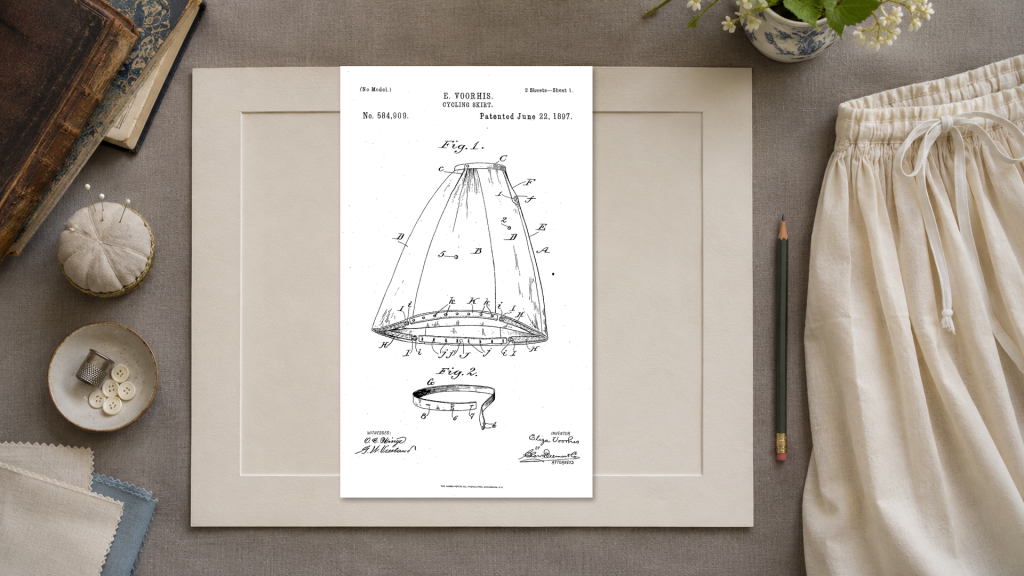
Featured image generated with AI. Original drawing from U.S. Patent 584,909, sheet one, on an AI-generated reading desk.
Eliza Voorhis of Brooklyn supplied a particularly good exercise. She filed her United States cycling-skirt application on September 9, 1896. The patent, number 584,909, was granted on June 22, 1897. The first sheet shows a generous skirt with its lower edge turned up for inspection. Along that edge are small fittings you could easily miss if you came looking only for the fashion of the silhouette. It is worth spending several minutes with the hem before turning to the views of the wearer.
Make a cover note before interpreting the dress
Copy the office, country, patent number, name, title, filing date and grant date. Give each date its own description. The date the applicant put the design before the office and the date the office issued the patent answer different questions. Neither supplies the day someone first cycled in a skirt made to that design. Record the page and figure numbers as well. A clipping of a single illustration can travel independently of the document that once identified it.
Check what kind of patent you have. The United States Patent and Trademark Office distinguishes utility applications, which describe how an invention works, from design applications dealing with ornamental appearance. Voorhis’s document includes a written specification, numbered claims and figures explaining an arrangement that changes the garment. The reading exercise here is for that kind of evidence. A drawing in a design patent calls for attention to what is shown as the claimed ornamental design.
Look for other names in their proper roles. A drawing can carry witnesses, an attorney or engraver as well as an inventor. A handwritten name near the drawing is worth transcribing together with its printed heading. Preserve an alternate spelling if it belongs to an index or an optical text transcription. A fuzzy scan can turn an initial into a different surname. Go back to the printed heading before attaching a family story to the wrong person.
Find the figure that opens up the construction
Voorhis’s Figure 1 lifts the rear of the skirt to expose the inside. Figure 2 separates out the belt or strap. The second drawing sheet shows views of the garment on a figure. Begin with the opened hem because it reveals the relationship that the worn view covers. As you move between sheets, keep the front, back and inner face clear in your notes. The near edge in a perspective drawing is easy to read as the front of the dress even when the description tells you otherwise.
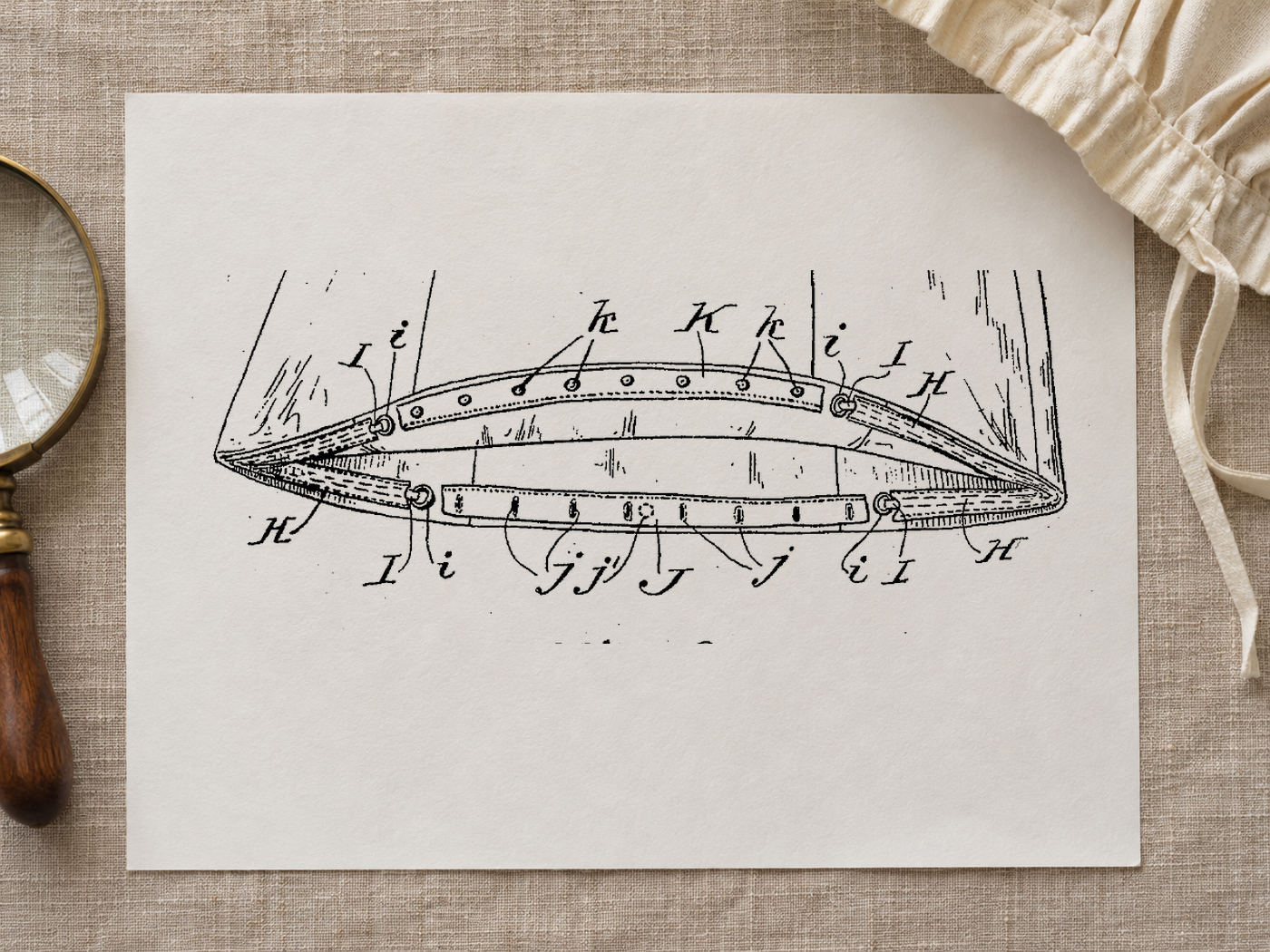
Pick just two references. The written description identifies H as the casings along the lower side edges and I as the drawstrings passing through them. On a working copy put a small pencil dot by the end of each leader line. Follow its tip all the way to the part. A line can pass across two other details on the way. Here the casing is the passage and the drawstring is the thing that moves inside it. Writing those two actions beside the letters is clearer than colouring the entire hem.
Now check the second location where the same letter appears. Is it the same part repeated on the other side, or is a related lower-case letter being used for something else? Retain capitalisation and any little mark attached to a letter. If a scan makes a symbol uncertain, refer to the position on the drawing as well. Another reader can find the lower side casing even if your typeface makes a capital I look like the numeral one.
Carry the references into one claim
The specification is the longer description of the invention. It can say how to manipulate the skirt, offer a preferred construction and give names to parts. The claims appear toward the end and describe combinations in their own language. Start with claim 2 in the Voorhis patent. In plain terms it puts drawstrings near the lower sides, fastenings at the lower front and back, and a belt that connects parts of the skirt. The relationship among those parts matters to her account of the change in shape.
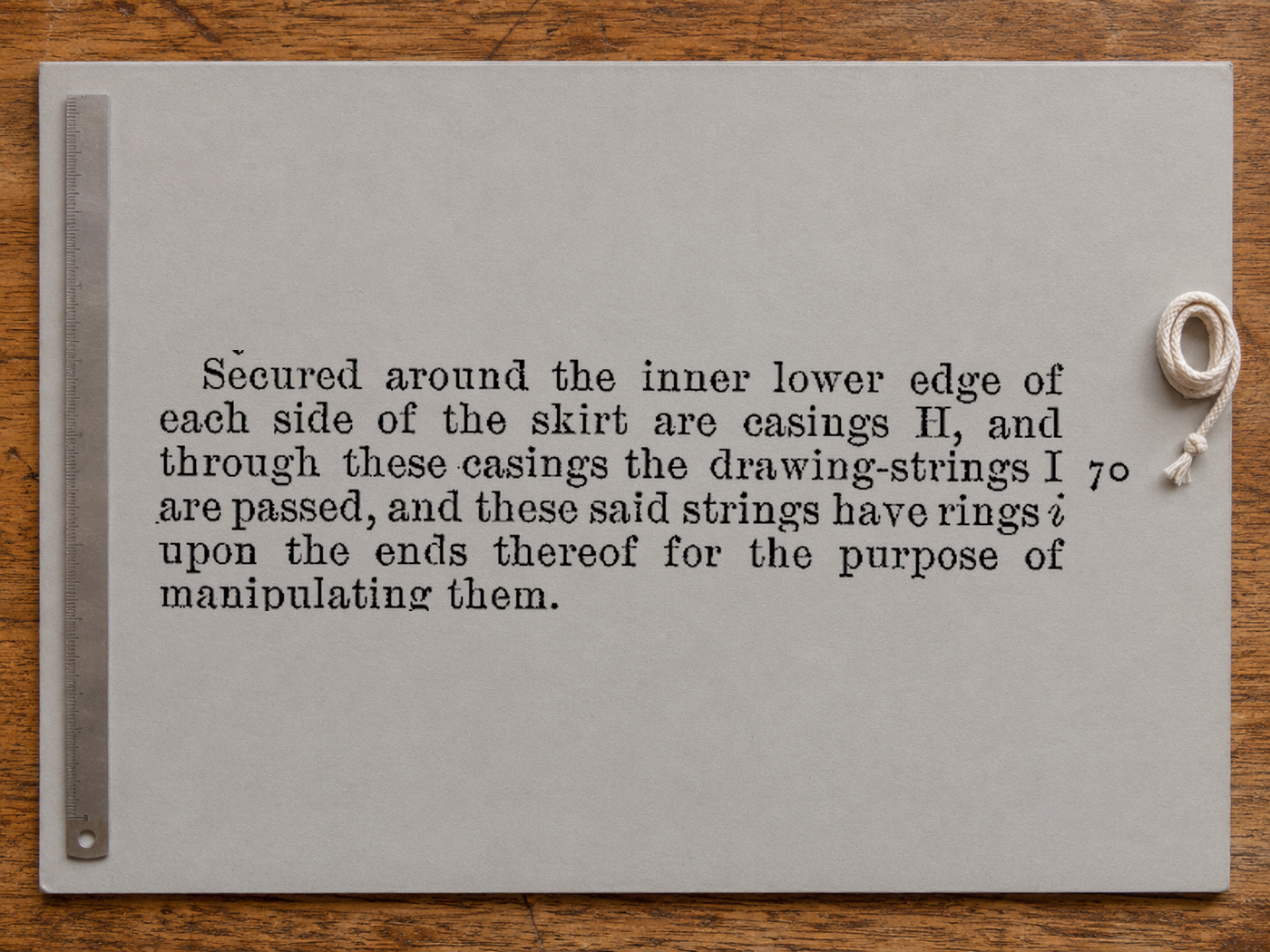
Divide a long sentence at its physical actions. One part passes through something. Another joins one edge to another. A belt attaches in a particular relation to the waistband and the lower portion. Make a three-column note with the wording in your own language, the place in the figure and the action you can follow there. If the claim uses a general term where the description names a particular fitting, preserve that difference. It helps explain why a single recognisable button tells you so little on its own.
Read the applicant’s sequence once without trying to reconstruct it in cloth. Then follow the paths on the drawing as if you were turning the garment over on a table. Distinguish a route that the applicant describes from a movement you have personally observed. No modern reader needs to claim to have tested the garment to point out that the drawstrings pass through casings and that the strips at the bottom have complementary fastenings.
An annotation can now do real work. On the sheet note that the raised hem in Figure 1 exposes the casings H and drawstrings I described in the specification, and that claim 2 pairs these features with fastenings and a belt. Add the grant date and the reference to the two drawing sheets. A person seeing only this annotated copy would have a route back to the document behind your reading.
Decide what the illustration cannot date
A full-length view gives evidence of how the inventor chose to explain the invention. Its sleeve shape, hair, shoe or bicycle may help a reader recognise the proposed use. Only some of those details appear in the claim. Take one away in your mind. If removing a fashionable hat leaves the described mechanism working in exactly the same way, the hat is a poor basis for saying the inventor patented an entire outfit.
A surviving skirt that gathers at one side is equally tempting. To compare it fairly, inspect the inside with permission. Look for the number and position of casings, where the cords go, how the lower front and back attach, and what happens at the belt. A modern mock-up can teach your eye to distinguish a guide from the string passing through it. It cannot establish the original manufacturer or the survival of Voorhis’s own skirt.
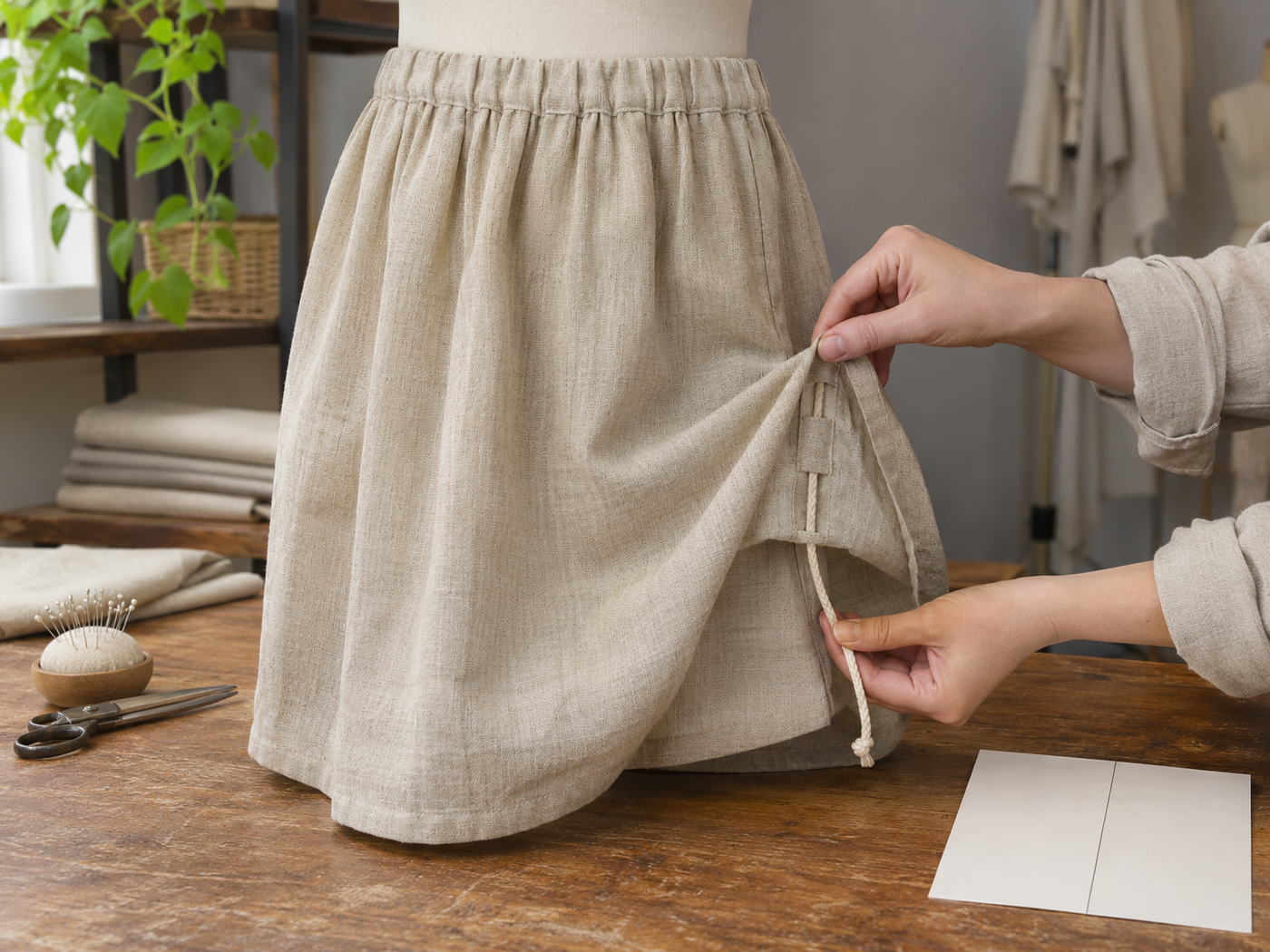
If you have access to a collection, request a study view of the inside hem and fastening points. Give the object number and the exact question. A front photograph may answer a question about a silhouette while leaving every relevant casing hidden. A curator may already have a reverse view or a conservation drawing. Credit the object record and give the date of the examination or image alongside your observations.
Look for the step from patent to manufacture
A maker’s marked sample, a production book, a labelled garment with a documented history, or a dated catalogue naming the patent can provide the next connection. Ask what each source actually records. A catalogue can establish an offer to sell a named model. An order or receipt can bring a particular transaction into view. A family recollection can identify the person remembered as wearing a skirt while leaving the fastening inside it undescribed.
Use the ordering details in the relevant catalogue edition when a retailer’s illustration seems to match. Check whether the patent number is printed, whether the description identifies several distinctive parts, and whether the catalogue names its manufacturer. Two skirts drawn for cycling may resemble each other for good practical reasons. Matching several independent details gives you a stronger lead, especially if an original label or dated letter confirms it.
For the Voorhis exercise, the patent establishes who described and claimed the arrangement in the United States and when the office issued it. The materials examined here do not identify a garment documented as a production example of this patent. Record manufacture as an open question and specify the evidence that would change that entry. A reader with access to a regional maker’s catalogue can now look for the actual combination instead of simply searching for any old bicycle skirt.
File the page with a sentence someone could read aloud beside a dress. It should name the inventor, the numbered patent, one small feature and what the feature connects to. End with the status of the garment evidence. The next person who lifts a skirt hem will know exactly what to look for and why finding a similar cord would be a beginning.

By Nell Aster