Start with the smallest part of the garment named in the claim. If the tag says the ribbed cuffs contain recycled cotton, follow the cuff yarn back through its knitting lot, yarn delivery, blend and recovered input. Record the amount and identifier at every handoff. Stop your conclusion at the first point where you can no longer connect a physical lot or a clearly defined accounting entry to the next record.
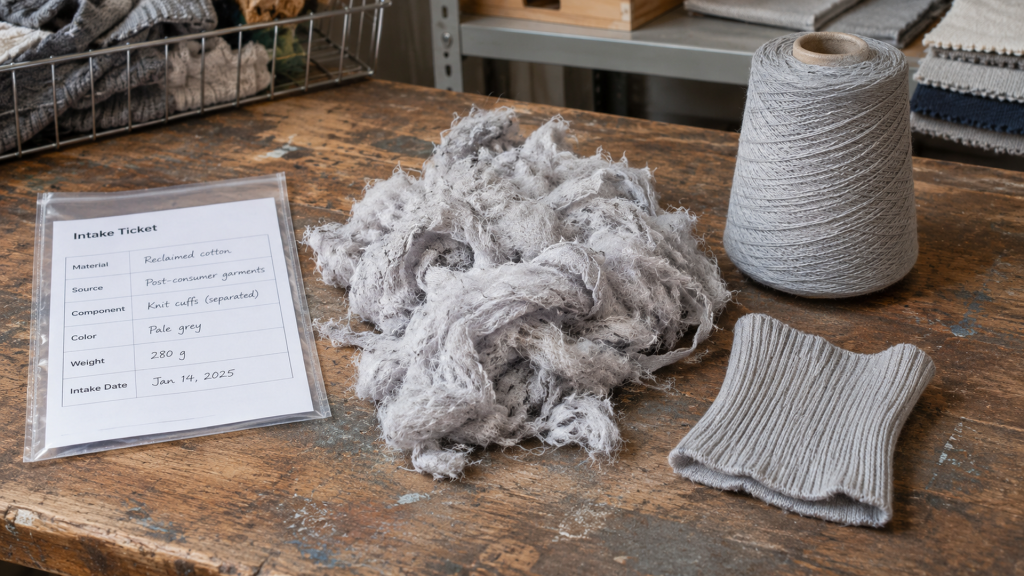
Featured image generated with AI. The component under discussion is the cuff.
A grey cuff makes a good object to keep beside the paperwork. Pull it flat enough to see the ribs, then turn the sleeve over and find where a different fabric begins. A sweatshirt body, sewing thread, label and cuff can all come from different sources. A successful trace of the cuff is already a result. It gives you a precise answer to a question about this part of the garment.
Copy the claim before you take it apart
Write down the exact sentence, its date, the garment style and colour, and where the claim appears. A sewn label attached to one garment and a maker’s page describing an entire collection can give the same word different reach. Keep a copy of each if their wording differs. Underline the noun immediately attached to the percentage. It could be the cotton in a yarn, the yarn as a whole, a particular fabric or the whole garment by weight.
Say what you would need to calculate the stated fraction. A figure for recycled cotton as a share of all the cotton needs the total cotton weight. A figure for recycled material as a share of a complete cuff needs a denominator that includes any other fibres in the cuff. A whole-garment claim introduces still more components. If the sentence leaves the denominator open, ask the issuer to complete it before doing arithmetic.
Give the claim a narrow working title such as grey rib cuff, style 12, October run. Put the label code, knitting lot and garment production lot on separate lines. One can split into several others. If two sizes used different cuff batches, keep their codes separate even when the care labels look identical. It will matter later that the photograph of a finished size medium came from the run you actually traced.
Read the material into the first operation
At intake, look for the supplier’s description of what arrived, its prior use if known, its lot identifier and the net quantity the receiver accepted. A transport ticket can establish a shipment weight including a pallet and wrapping. The quantity entering the blend may be smaller after unpacking, sorting or removal of unsuitable material. Record both figures with their units and the reason for any difference that the receiver can document.
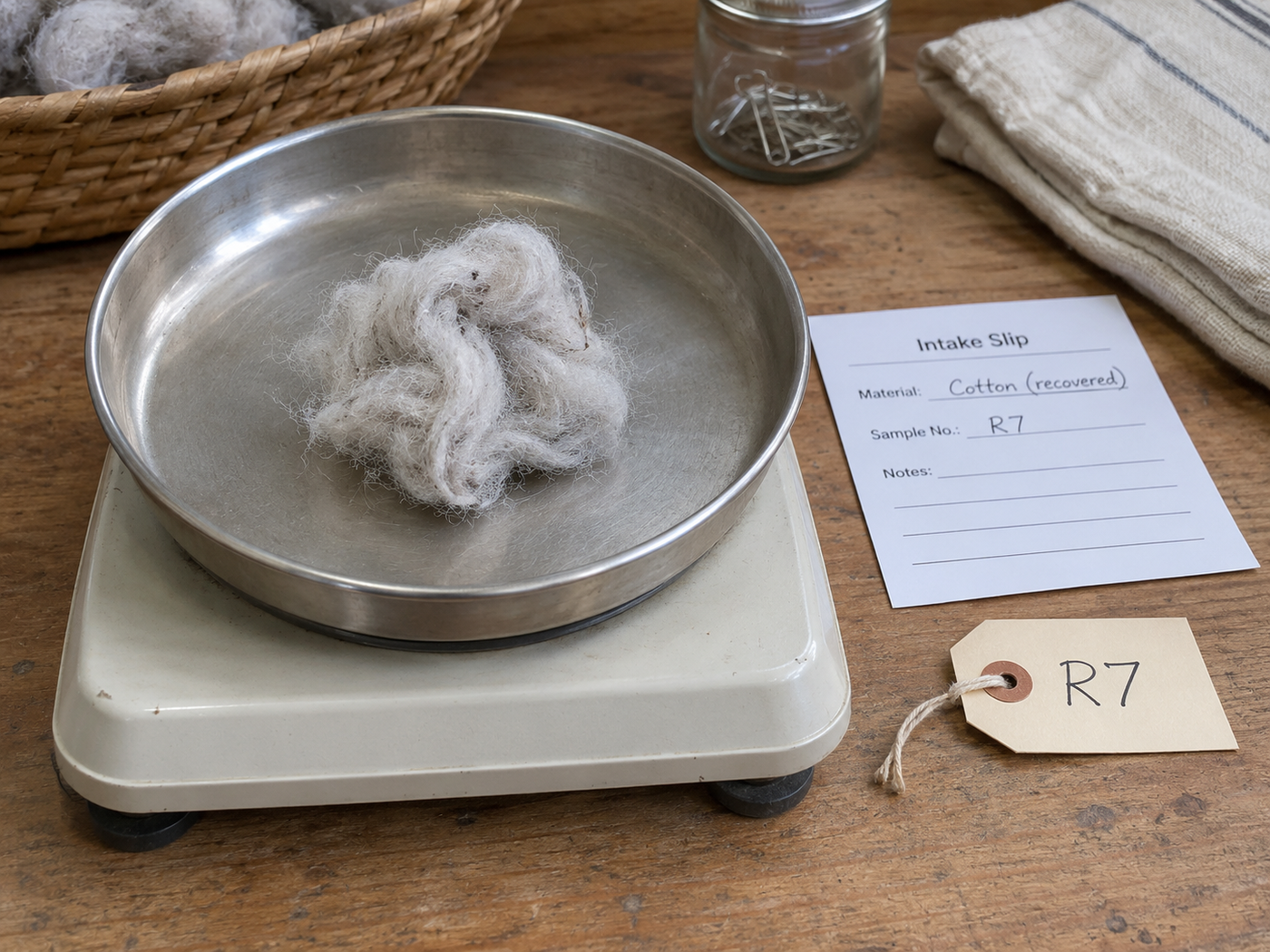
Ask the issuer what establishes the description “recovered.” An intake slip recording clean cutting scraps from a named operation gives you a particular origin to investigate. Grey fibres in a bag look much like other grey fibres. For a source described as factory offcuts, check how the cutting room recorded the offcuts leaving its run before carrying that description into a claim about the yarn.
Start a simple route on paper. On the left of each line put the outgoing lot, date, quantity and issuer. On the right put the incoming identifier and quantity recorded by the next operator. Leave room in the middle for a unit conversion, a split or a remark about who confirmed the relationship. An arrow drawn between two similar shades is still just an arrow until you can say why the receiver treats one as the continuation of the other.
Mark the place where two streams become one
Imagine a training example in which the spinner accepts 30 kilograms of recovered cotton as lot R7. The blend ticket shows that 24 kilograms from R7 entered a specific mix with 56 kilograms of other cotton. Six kilograms of R7 stayed in stores. On this record, recovered cotton represents 24 of the 80 kilograms issued to the blend, or 30 percent by input mass. The receipt for 30 kilograms alone could never give you that answer.
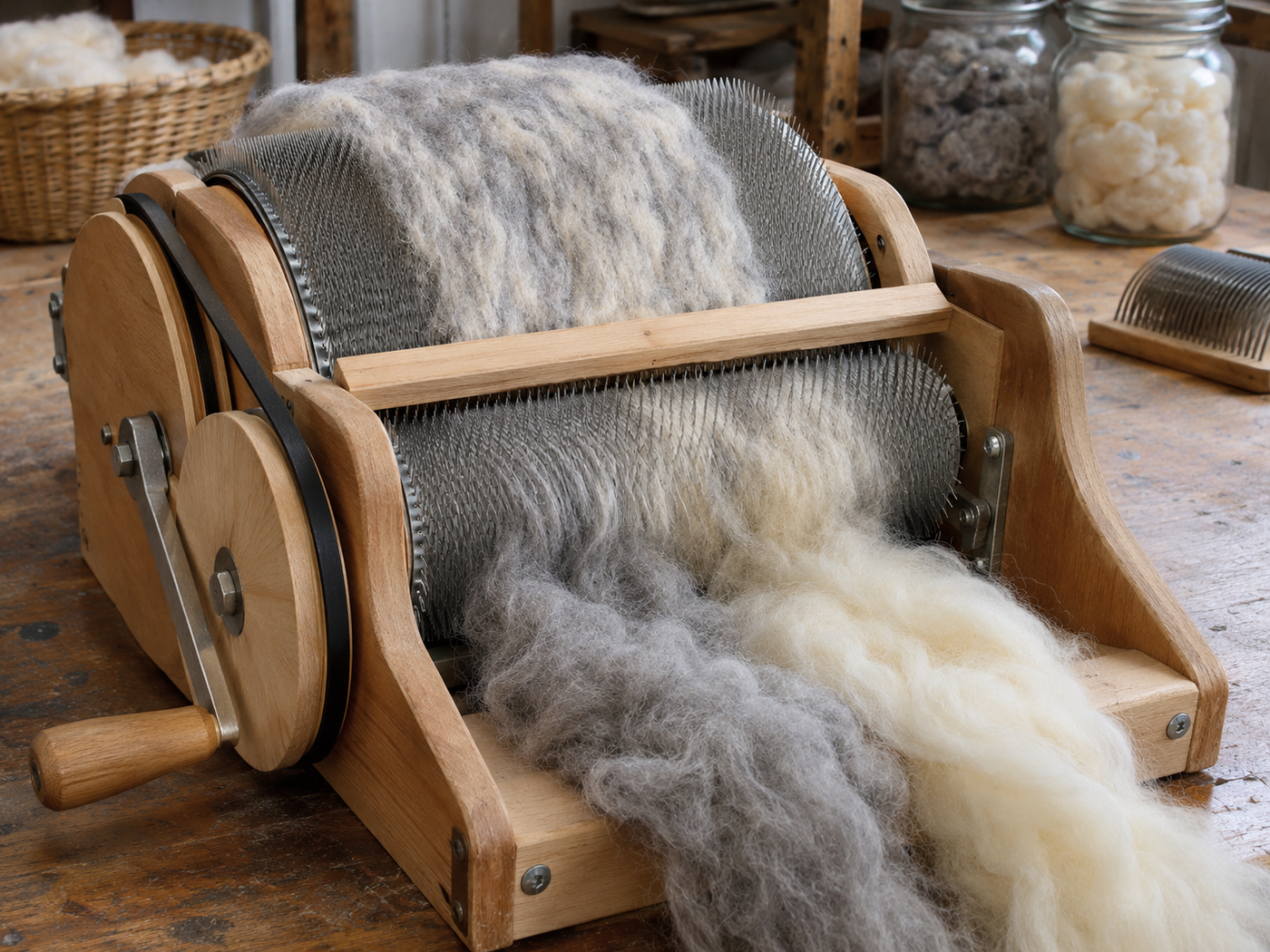
Notice what changes at the mixing point. Before blending, a labelled container may identify a physically separate lot. Afterwards you can follow the blended batch through a spinner’s identifier if the records preserve it. You cannot point to a grey strand in a cuff and recover which of the original containers supplied its fibres by looking at it. Put the new blend identifier beside both input lines and mark the moment the streams met.
The spinner might record only 76 kilograms of acceptable yarn after processing this example batch. Ask what the remaining four kilograms represent and whether the operator knows the composition of the loss. You can report the 30 percent input fraction and the output weight. Applying that fraction to every delivered cone or claiming an exact finished-fibre fraction requires an appropriate basis that the records or applicable method actually supply. Keep an unmeasured loss visible.
Keep a pencil subtotal beside each branch of the route. In this exercise the six kilograms still in stores and the 24 kilograms issued exhaust the thirty received. If another blend later draws on the six, give that blend a new branch. Copying the full thirty onto both recipes would make two plausible-looking product claims draw on the same recovered cotton.
A system may also allow a quantity to be allocated in records across defined inputs and outputs under particular rules. Ask which chain-of-custody model the claim uses and what physical mixing that model permits. Record the scheme, version and relevant dates supplied by the issuer. A book entry representing an allocated quantity and a dispatch note tracking an identifiable batch can each support claims in their own terms. The wording you use for one may misdescribe the other.
Follow one delivery all the way to the cuff
Ask the knitter which cone or delivery supplied the rib run. A dispatch for ten cones can split across several colours, sizes or customers after receipt. Match the delivery number to the receiving note, then read the yarn issue against the job card for the cuff. Keep a sample if one is available to you and mark its face, code and date. A sample clipped from a display card needs its own identification before it can stand for production.
The garment maker may buy knitted cuffs in pairs by the carton while the knitter issues yarn by weight. Resist the urge to convert pairs into kilograms using a guessed cuff weight. A batch connection can survive that change in units if the carton and sewing job carry matching identifiers. A quantitative claim about the whole garment needs measured or otherwise documented component weights as well. Write separately what the codes establish and what quantities can be reconciled.

Look across the dates. A delivery recorded after a particular sewing run ended cannot explain the cuffs already attached unless there is a documented correction or a different meaning for one of the dates. Ask whether the date is for dispatch, arrival, invoice or entry into a monthly ledger. If the producer explains the discrepancy, retain the explanation and the document that resolves it alongside the first record. Changing the date silently would remove the reason you needed a second look.
Check exactly what a certificate covers
Textile Exchange’s Content Claim Standard describes chain-of-custody requirements. Its published guidance distinguishes a scope certificate for an organisation’s certified scope from a transaction certificate attached to eligible material transactions. If a producer invokes a scheme, check the document type, issuer, dates, material, quantity and businesses covered. A company appearing on a scope certificate gives you a starting point for questions about a particular shipment. You still need the connection to the shipment behind your cuff.
Keep scheme-specific conclusions inside the scheme and edition you consulted. A handling rule for one standard can be quite different from a brand’s own inventory convention. Ask who verified the outgoing claim and whether the precise product language has a basis under the system being invoked. A voluntarily shared invoice can support a batch connection even in a case that makes no certification claim. Name the evidence you actually saw.
Write one sentence the route can carry
For the fictional blend, suppose you can match the intake, blend and yarn dispatch but the knitting room only has a monthly total. A sound conclusion is that R7 supplied 24 kilograms to an 80-kilogram input blend and the spinner dispatched yarn from that batch. The link from that delivery to these particular cuffs remains open. Ask for the knitting job’s yarn issue or the receiver’s lot cross-reference. You have identified both the limit and the next useful record.
If the cuff job and the garment run can be matched, extend the route to the component and name that run. Leave the body fabric outside the sentence unless its own records support including it. To practise following a material through a split delivery with a different question in mind, follow the handoffs in a flax-to-garment batch. Keep your cuff tag with the final worksheet. The finished note should take a reader from that little ribbed edge to a specific recorded input, with every gap still visible on the way.

By Alma Quillan