Begin with the paper as the publisher arranged it. Find an intact sheet from the same edition, match each loose outfit to its figure, and copy the words printed beside it. You can then make a map of the occasions the publisher imagined for that figure. To ask whether people really wore those clothes for those activities, turn to a separately dated source with people or garments of its own.
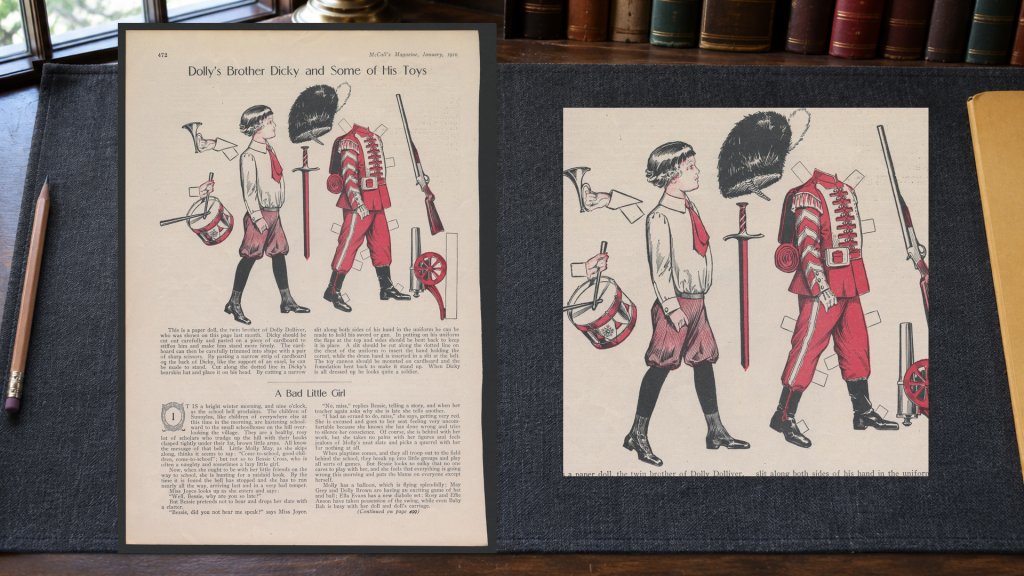
Featured image generated with AI. Original McCall’s page, January 1910, from the University of North Texas Special Collections, displayed in an AI-generated setting.
A useful starting point survives at the University of North Texas. The January 1910 issue of McCall’s Magazine printed Dolly’s Brother Dicky with a costume and toys on the same page. Below them begins a different story. The whole page tells you something a little envelope of cut pieces cannot. The reader met the child, his things and the publisher’s invitation to play in a particular arrangement, with the rest of the magazine still going on underneath.
Decide what belongs to this edition
Give the sheet a record before giving the doll a wardrobe. Copy the title, publisher or magazine, issue date, place or market when known, page number and the institution’s identifier. Note whether you are looking at an uncut issue, loose sheets from a book, or an owner’s assembled set. Record any date written by an owner separately. A child might have received a magazine years after its publication or kept the pieces together for several birthdays.
Look at both faces if access allows. Advertising on the back can identify a publisher or help you locate the sheet in an issue. A handwritten name can identify an owner if its history is known. A caption running into the gutter might continue on the facing page. Copy a complete spread when permissions and access allow, including the binding edge, before making a detail view of the clothes. The blank margin can help establish exactly where a cut piece belonged.
Compare the size and printing of the intact reference with your loose pieces. An online scan scaled to fit the screen can make a dress look right until you restore its printed dimensions. Check a stated page measurement, an identifiable border or a measured feature on the sheet. A reprint can reverse a figure, change the colours or collect outfits once sold separately. Treat the edition as a finding to support, especially when a familiar character appears across several issues.
Reunite one costume with one figure
Choose a loose piece whose shoulders and waist can be compared to an intact figure. Look at the direction of the pose, the angle of each elbow, the height of the neckline and where the hem leaves the shoes visible. Tabs give another clue. A tab intended to fold over a shoulder belongs above that shoulder when you hold a copy in place. A tab missing from fragile paper leaves a different edge from the smooth printed outline of a sleeveless dress.
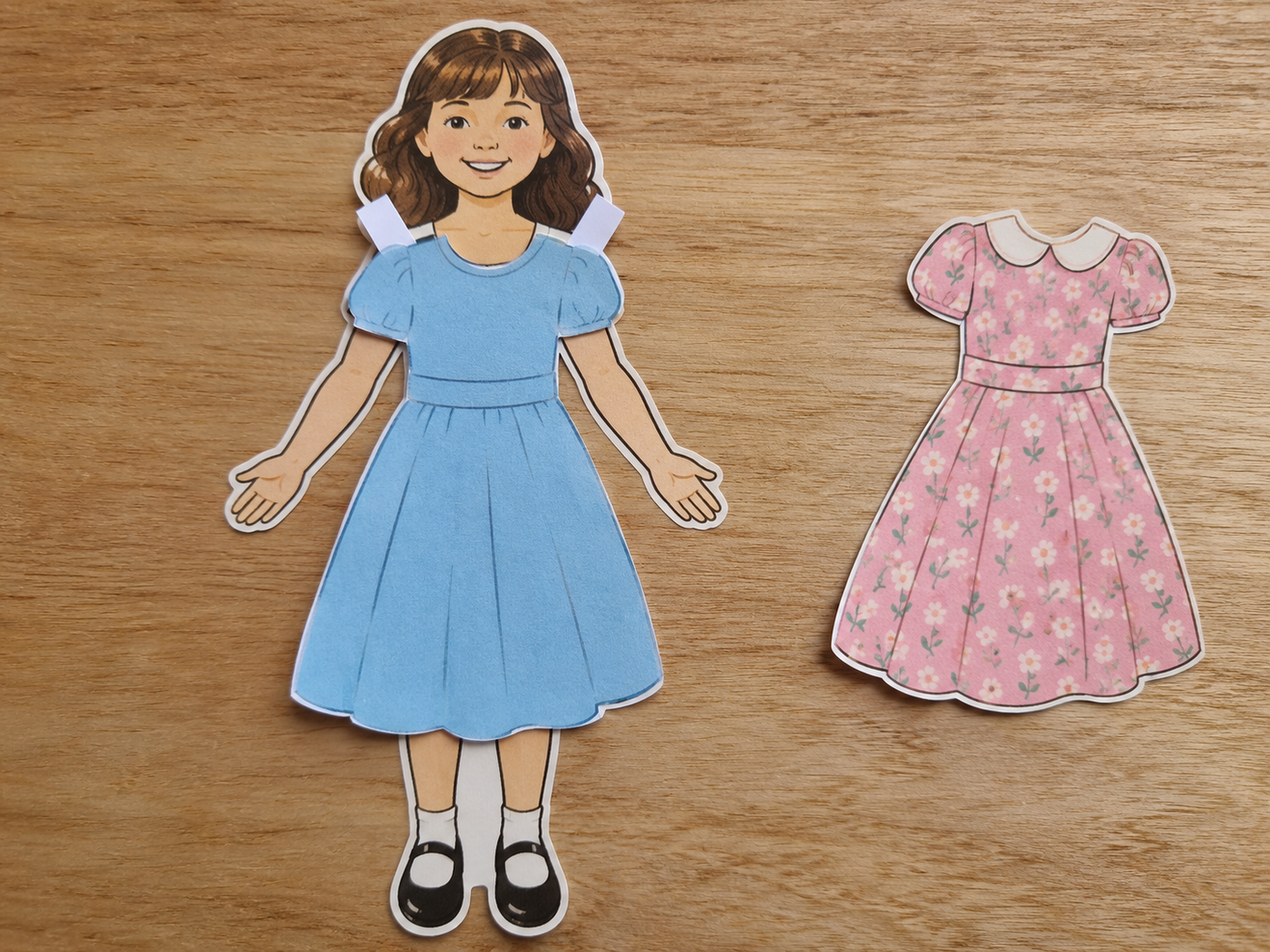
Work with a copy or a digital tracing if the original is brittle. Fold a new tab on the copy and keep the surviving original flat. If the skirt fits two figures at the waist, the tilt of a shoulder or a hand printed at the hip may decide between them. Describe the evidence for the fit. “Fits the left shoulder and clears the figure’s raised right hand” gives a second reader something to test. A matching shade of blue by itself gives them much less.
An owner may have drawn an extra coat on the back of an envelope. Give that piece a record of its own. Its cut edge, different paper and a family member’s recollection can be evidence of how someone used the set. Keep owner-made additions visible beside the publisher’s wardrobe. They answer an especially interesting second question about which clothes a child wanted to add to what was offered.
Copy the caption before naming the occasion
Use the shortest exact words on the sheet that identify the activity. Sometimes the caption supplies a day, a place and a companion. Sometimes it names only the garment. An evening dress with no caption can be described by its printed shape and details. Calling it a dress for the opera would add a destination the print may never have assigned. Make separate columns for the printed words and your interpretation.
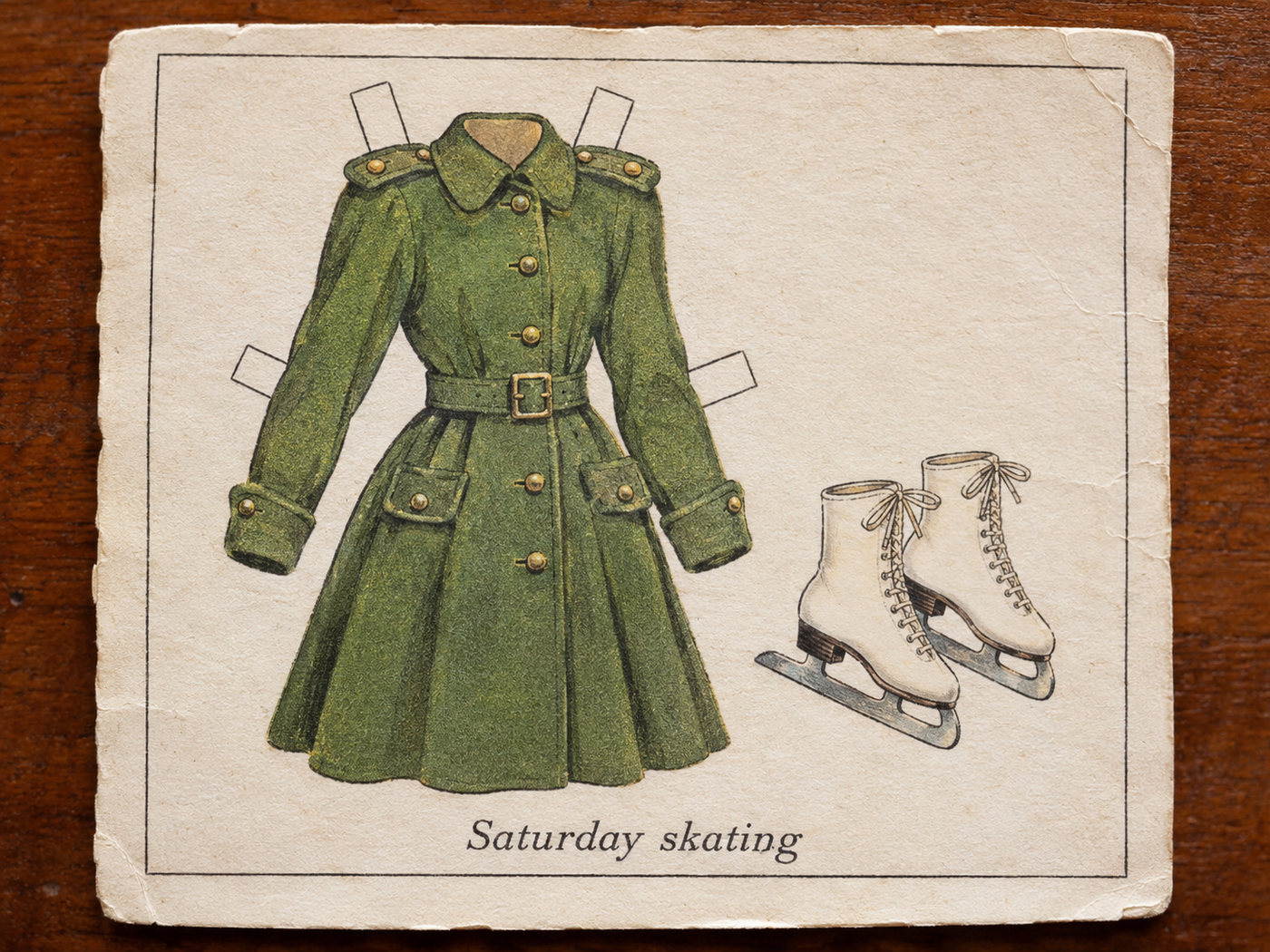
For practice, consider the invented coat captioned “Saturday skating” in the illustration. The phrase supplies both the day and activity. The tabs and the position of the coat tell you about attaching the piece to the figure. The green colour and drawn skates tell you what the illustrator wanted the reader to recognise. None of those facts establishes that a child in a particular town went skating on Saturdays or owned a coat like this one.
Build the map across the whole set. For each outfit enter the figure, the printed occasion, any accessory needed to complete the scene, and the evidence for its place on the sheet. Count repeated occasions even when the clothes differ. A publisher might provide three party outfits and only one indoor work dress. If you have two loose gowns and an incomplete set, record two surviving gowns. You need the whole set before saying how often its publisher represented a party.
Ask what the publisher actually offered
A trade catalogue can help put the set back in its market. The American Antiquarian Society holds McLoughlin Brothers’ catalogues and price lists, including catalogues that list paper dolls alongside other goods. Match the publisher, edition, title and contents before borrowing a description. A catalogue from a different publisher is evidence of a different offer. The McCall’s magazine page and a boxed commercial set can be compared as formats without being assembled into a single wardrobe.
Use the edition and ordering terms in a contemporary catalogue to check whether an outfit came in the base packet, on a later sheet or as an extra. If a wrapper promises six costumes and your packet contains five shapes, examine what the publisher counted as one. A hat and coat might share a caption. An extra figure might have its own outfit. An owner could also have swapped one dress with a friend.
Consider how the buying invitation frames the clothes. A sheet bound into a magazine reaches a reader in the middle of other stories and advertisements. A boxed set may carry its activities as a sequence printed on the lid. Record any explicit message about whom the publisher addressed. A later owner or family informant can tell you who actually played with this copy. Allow those two people, imagined buyer and known owner, to differ in age, place or interest.
Introduce one independent picture
The Library of Congress catalogues a National Photo Company photograph of four girls skating with the Washington Monument behind them, dated about 1919 in the record. The print gives a place, an activity and particular people together on the ice. Set it beside the invented skating caption and look at the length and shape of the outer layers. A common activity gives you a reason to compare the two images. It does not make the photograph evidence of the date or market of the imaginary coat.
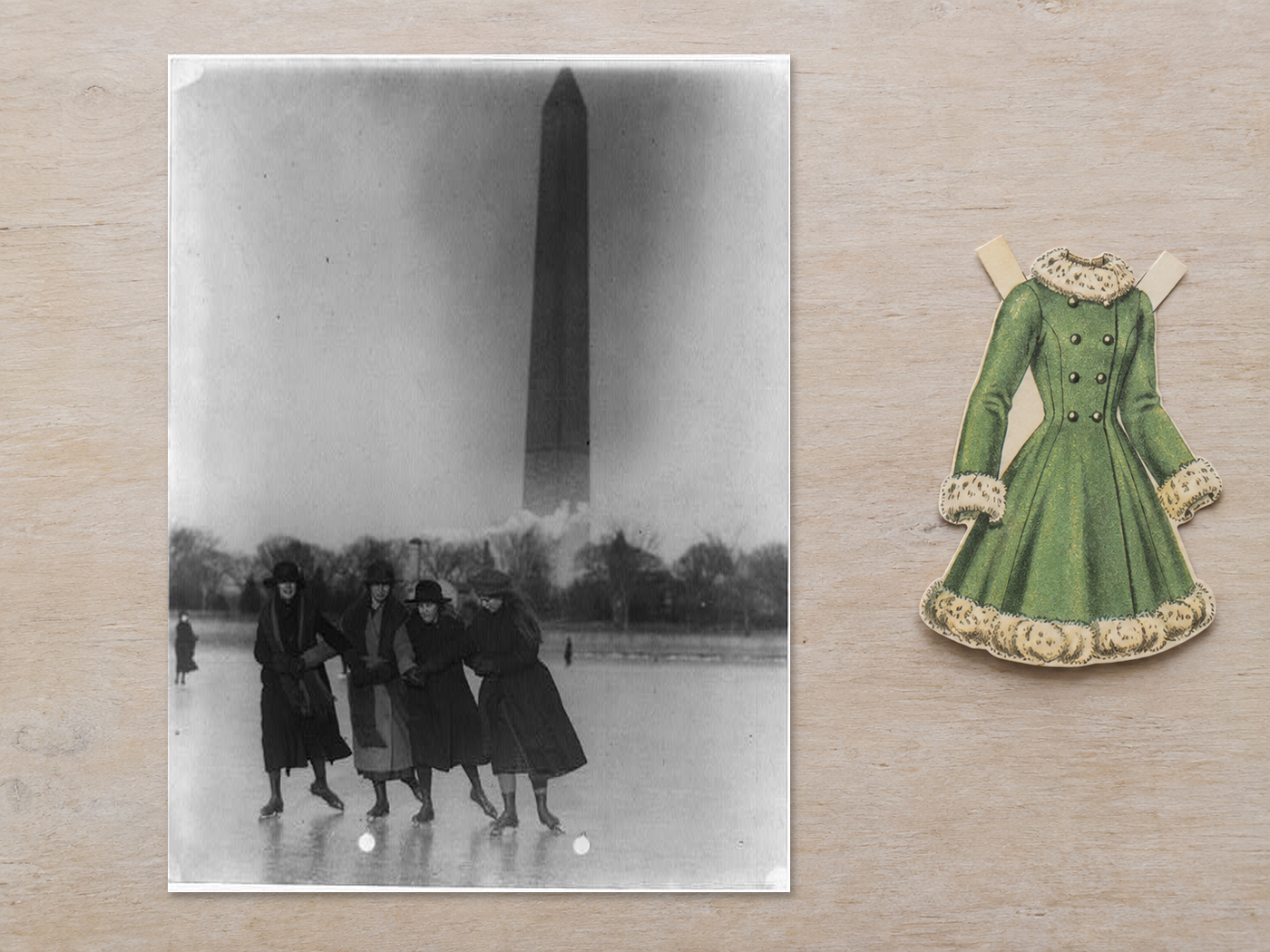
Record who assigned the photograph’s date and whether it is exact or approximate. Describe only what remains visible in the particular print. A coat fastened at the throat might hide what was worn underneath, and a dark skirt can merge with a second figure in a small reproduction. If a published picture is cropped, follow the photograph into its published crop before making a claim about a missing garment detail.
The same caution works in reverse. A doll sheet that omits wet hems, borrowed skates or trousers tells you which details the publisher left off the sheet. It does not give you a count of what people wore at the pond. A dated family photograph or recollection from another town can add another setting. Keep its date and speaker with it, and note the name they used for the garment if you have permission to share it.
Keep the gaps in the wardrobe
Finish with a short set description that someone could use to check your map. Give the number of surviving sheets and pieces, the figure or figures they match, the occasions explicitly named, and the pieces whose status remains open. Name a missing sheet if a wrapper or intact reference establishes that it existed. An empty paper outline can sometimes identify precisely which shape was cut away even when nobody knows where the piece went.
For the teaching coat, the strongest sentence is modest. Its invented publisher paired a green coat with a named skating outing. The Washington photograph supplies independently dated evidence of people dressing for skating in a particular place. The January 1910 McCall’s sheet supplies a separate, verifiable example of how a publisher arranged a figure and accessories. Keep these records under their own names. Someone opening the envelope years later will know which wardrobe was printed, which was assembled and which was imagined for the exercise.

By Nell Aster