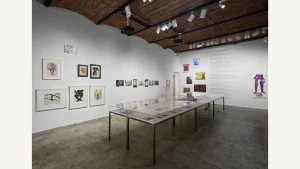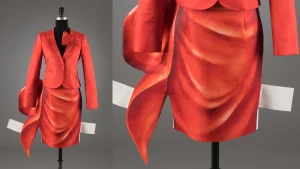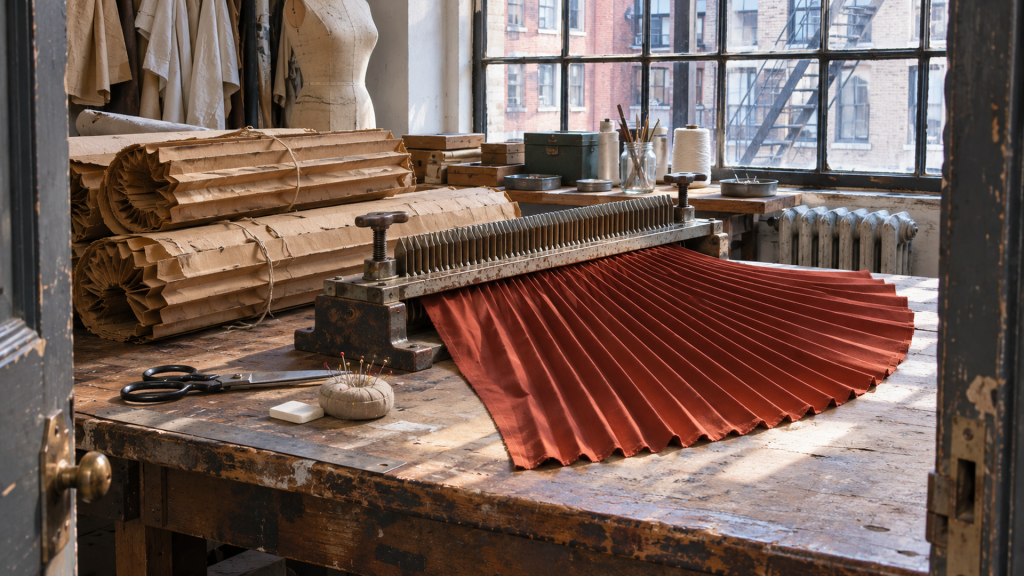
Illustration of a pleating workroom and sample. The festival programme announced a visit to Tom’s Sons. AI-generated image.
Open House New York made an unusual invitation for Saturday, October 17, 2026. Its weekend programme in Manhattan included Tom’s Sons International Pleating, a family business in the Garment District. A finished skirt usually leaves the maker’s best explanation behind on a shelf. At a pleating shop, the thing worth asking to see is the paper that gave the cloth its folds.
Featured image generated with AI. The workroom illustrates the process described by the pleater.
The citywide festival ran from October 16 to 18. Tom’s Sons normally deals with a different kind of visitor. A designer or pattern cutter may arrive with an idea for a garment and need someone else to turn a drawing into repeatable folds. The firm describes its work to the Council of Fashion Designers of America as extending from sample development through production. A first sample might occupy one end of a bench. Folds for an entire run of skirts have to agree all the way down the rack.
The question before the skirt
Suppose a customer walks in with a drawing of a skirt that opens like a fan. How long is it? Where should the folds begin to spread? You could agree on a colour and a waist measurement and still have a dozen possible answers. Tom’s Sons puts specific questions like these in its instructions for ordering sunburst side pleating. It asks for the skirt length and a photograph or an example of the desired shape. They tell the pleater something a fabric swatch alone can’t convey.
For this particular order the firm specifies half-circle panels. They have to be cut before they can be pleated. A customer who cuts a piece too small has already taken a choice away from the person at the table. With the instructions open, you can follow a decision a long way back from the rail where the finished skirt hangs. Someone had to establish where its hem would fall while the cloth was still flat.
What’s inside the paper
A hand-pleating mould can look like a great deal of folded brown paper until you see where the fabric goes. Two matching surfaces close round it. A ridge on one meets the hollow in the other. Close the two without the cloth and you can see how they fit. Put the cloth back and those same folds direct where its surface has to turn. In the hand process described by the craft ateliers at le19M, steam sets fabric held inside the mould.
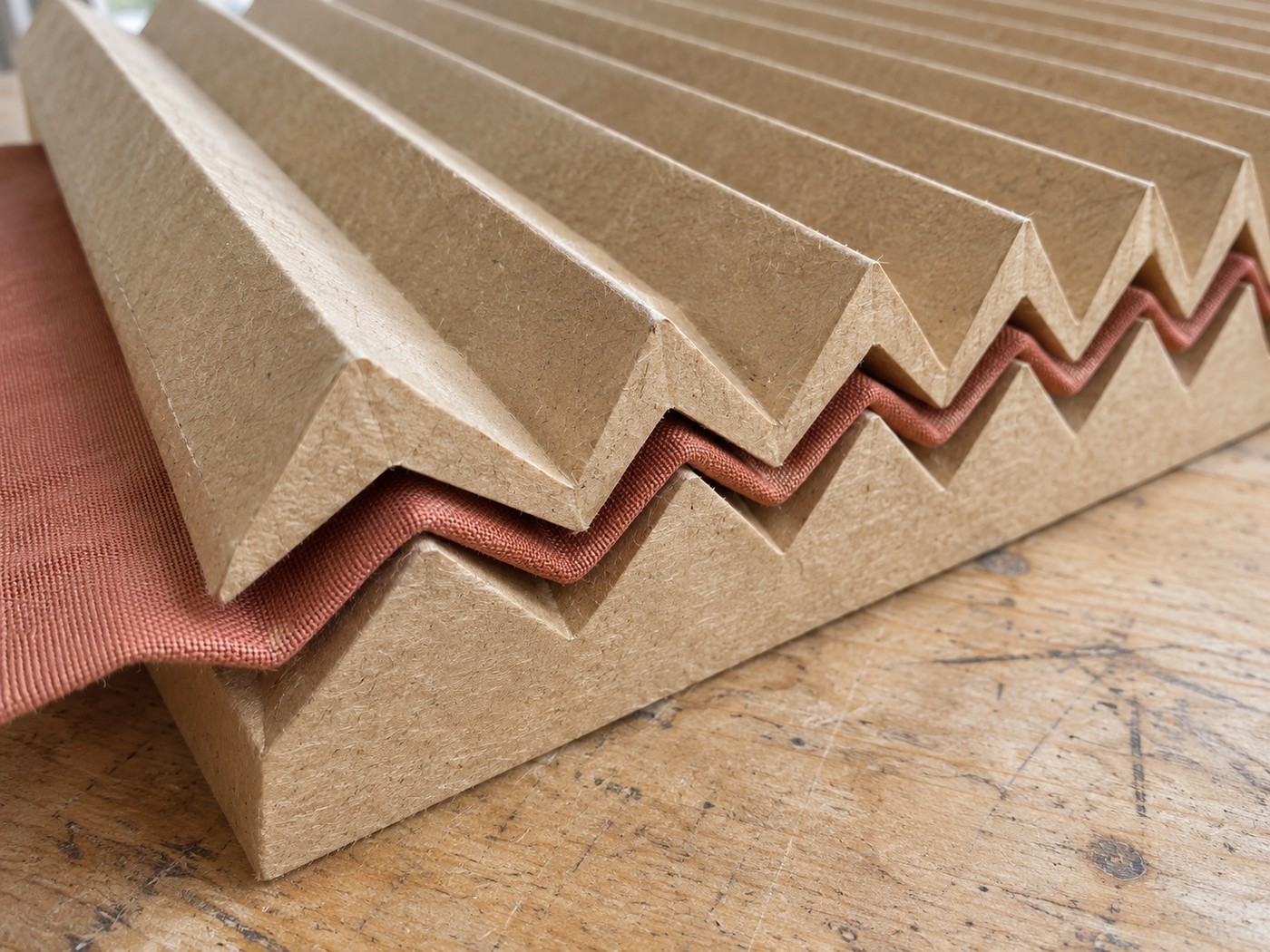
The illustration here shows that arrangement in section. It gives you a useful question to take to a demonstration. Which paper edge corresponds to the waist? If you can keep one ridge in view as the mould opens, you can trace it all the way to the hem. You can try the comparison at home with two paper skirt panels sharing a waist edge. A paper trial will show where the extra width goes. Only the actual fabric can tell you what happens when somebody walks in it.
Put the specialist back in the credit
A label sewn into a skirt might give you the designer’s name, the fibre content and the place of manufacture. There’s rarely room on it to explain who prepared the panel or who decided which mould to pull from a shelf. An event listing can supply a different sort of record. Here it puts a name and a Manhattan workplace beside a process that can disappear under a single word on a label. The same question applies when you trace the people credited on a collection.
The October programme establishes the invitation. The technical example above comes from the firm’s own working instructions. For a visitor, the question worth bringing to the bench is quite small. Pick out one fold in a picture of a skirt. What did the pleater need to know about the person who would wear it before making the first crease?