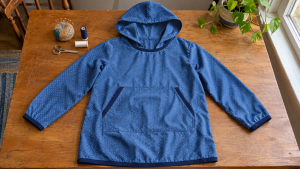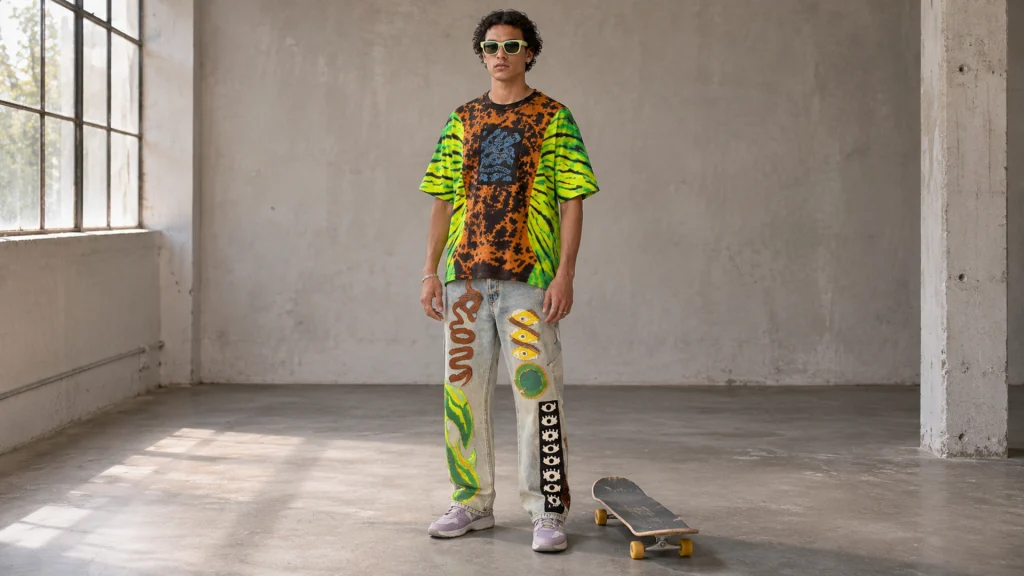
Studio restaging of the skate look from MEANT 2 B. Parnian Sane’s linked runway photograph documents the original appearance. AI-generated image.
At David Lam Hall in Vancouver on October 18, a model rolled down the runway on a skateboard. The shirt had green tiger stripes on the sleeves and spots across the front. Narrow strips of printed cloth ran down pale trousers. The show listing gives the first part of the credit in one line, Pattern Nation x CLAIRE UPCYCLED + JAQKE. To find out how those printed pieces got into the collection, it helps to start with the person who decided what to print on.
Featured image generated with AI. It restages the look in a studio. The original runway photograph is linked in the dated photo note below.
Claire Scott, who works as CLAIRE UPCYCLED, printed original designs onto scraps. Pattern Nation contributed textile designs and sourced deadstock in South Africa. Jaqke Austdone worked on how the elements were composed. These are the roles the artists set out for their spring 2027 collection, MEANT 2 B, before the show. The skating look gives you a way to read those credits. Start with the marks visible on the trousers, then check which decisions the collaborators claim for the collection.
Start with the trousers
Look down one pale leg. Three yellow eye shapes run down the thigh towards a green circle at the knee. Farther down, a narrow black strip carries a succession of small white eyes, some with lashes. With the two legs close together on a skateboard, those vertical strips remain easy to pick out. Up at the shoulder, the transition from a stripe to a spotted panel is visible from the other end of the room.
Printing on scrap changes the order in which a pair of trousers can take shape. An artist can put a design on a small piece of available fabric. Whoever arranges the pieces then has to decide which way up it goes, how much of the design will survive a seam, and what it will sit next to. A printer could supply the same piece of marked cloth to two people and get two very different pairs of trousers back. Try tracing a single block impression on a bandanna, then follow a printed strip on these trousers. Here the ink has one edge, and the fabric it lands on has another.
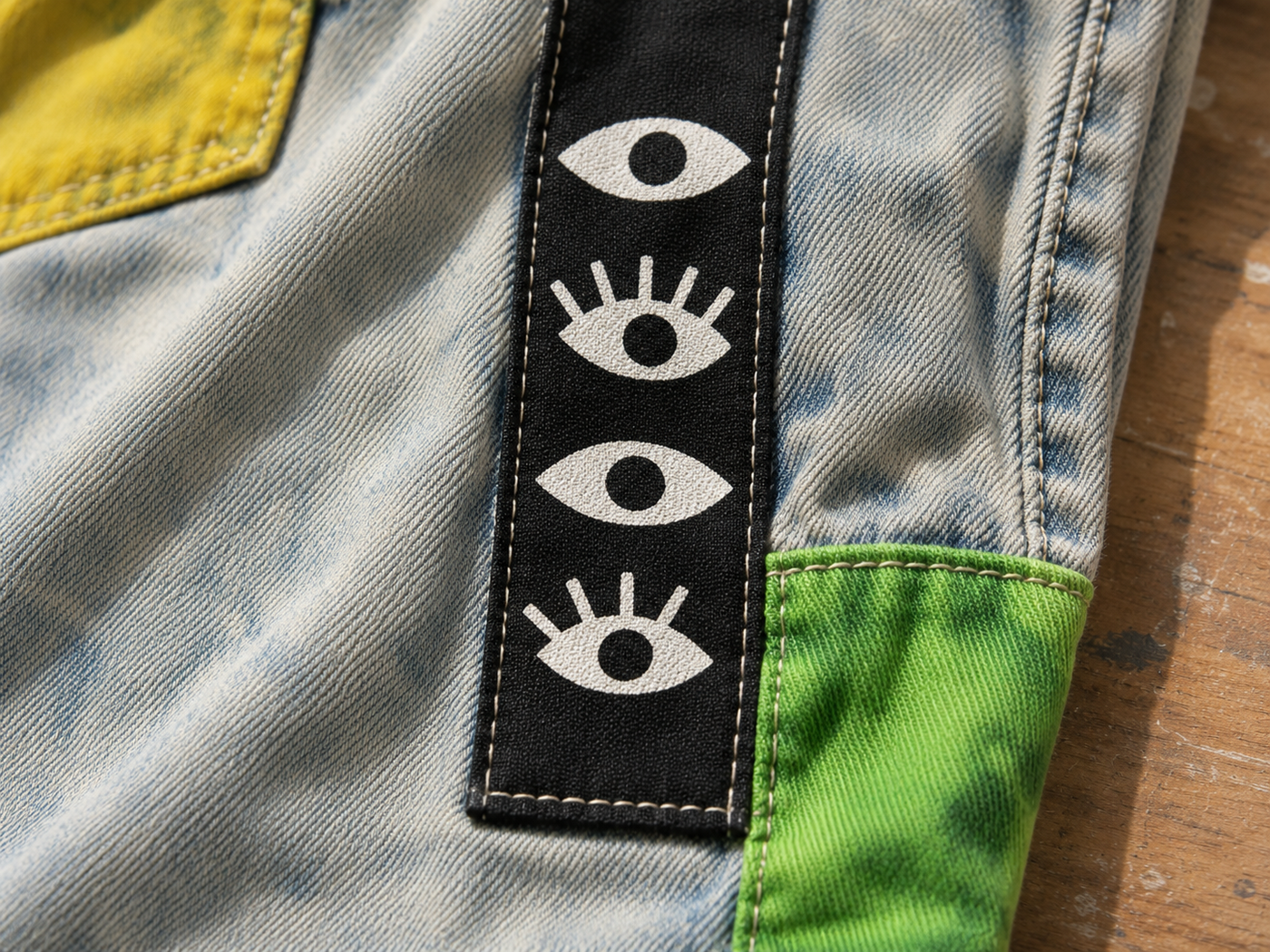
The designers’ collection statement published on October 1 is quite specific about that first decision. It names Scott’s screenprinting on scraps, credits Austdone with composition, and identifies Fabcycle in Vancouver as another source of surplus fabric. The artists give that credit for the collection as a whole. On the photographed trousers you can follow the white marks down the shin to the seam. A caption can describe where that strip sits and credit Scott separately for the printing method the artists describe.
Keep the other names in the frame
Compare Vancouver Fashion Week’s designer listing with Pattern Nation’s own announcement of the show. Scott’s label links to the runway livestream and directs viewers to the collection at 14 minutes 40 seconds. The headline on the artists’ event calendar abbreviates the billing. Inside the announcement, all three collaborators appear, along with the October 18 date and the venue at the Chinese Cultural Centre of Greater Vancouver. A reporter working from the calendar headline alone could lose Austdone before even reaching the clothes.
There is a fourth credit at the back of the runway photograph. The screen carries the words NEON LOVE by ZULA. ZULA’s own event listing identifies the jewellery line as an accessory collaborator for this show. That accounts for the name on the screen. The skateboarder also wears pale glasses. Their colour might fit the mood of the show, but the event listing gives no maker for that pair. It takes very little cropping to lose the projected name and very little guesswork to attach it to the wrong object.
A caption you can carry back to the photograph
Here is how the look can travel with its credits intact. Model on a skateboard in a mixed-print shirt and pieced trousers, MEANT 2 B, Vancouver Fashion Week, October 18, 2026. Collection by Pattern Nation, CLAIRE UPCYCLED and Jaqke Austdone. For the collection, the artists credit Pattern Nation with textile design and South African fabric sourcing, Scott with screenprinting on scraps, and Austdone with composition. NEON LOVE by ZULA accessorized the collection. Runway photograph by Parnian Sane.
Photo note, October 26. Parnian Sane’s Vancouver Weekly gallery documents the October 18 appearance. The gallery became public the day after this article’s October 25 editorial date. Start with the photograph at the top of the gallery. If you trace what a crop leaves out of a fashion photograph, keep the screen, the trouser hems and the wheels in the first view. Each resolves a different part of that caption.