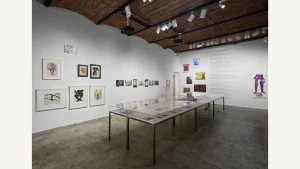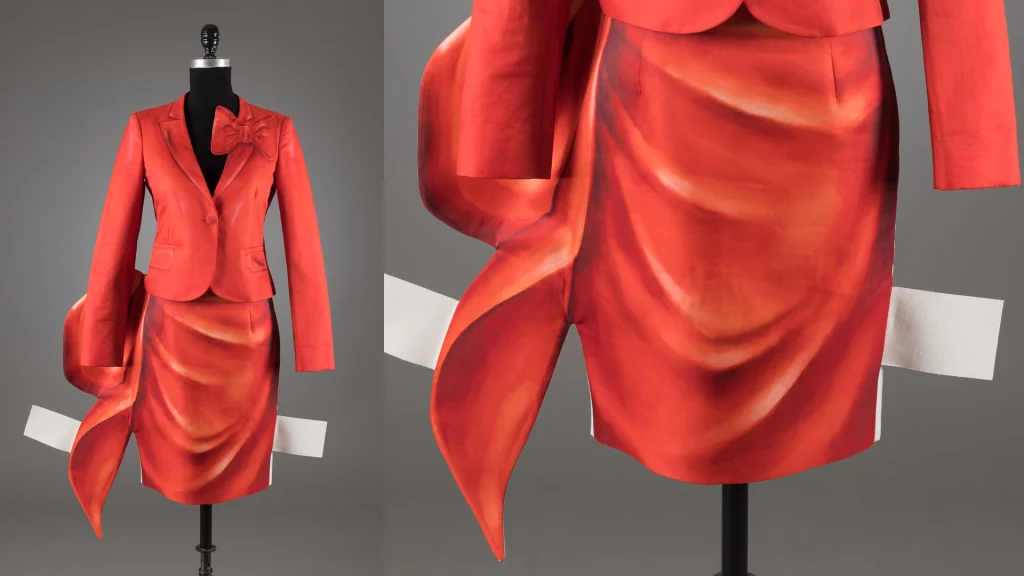
The museum’s full view and a detail of the protruding tabs on Jeremy Scott’s spring 2017 ensemble. Image courtesy of The Museum at FIT. Moschino by Jeremy Scott, spring 2017, museum purchase.
On September 16, the Museum at FIT opened Doll Dressing in New York and put a pair of white paper-doll tabs at a grown person’s hip. They jut from a red Moschino skirt designed by Jeremy Scott for spring 2017. In the museum’s photograph the tabs point out into empty space. A child dressing a paper figure would have folded them out of sight. Scott left them where you could see the joke from across the room.
Featured photograph and detail courtesy of The Museum at FIT. Moschino by Jeremy Scott, spring 2017, museum purchase.
There’s a second trick nearer the waist. The jacket appears to close with a big round red button, complete with a little dark stroke beside it that looks like a buttonhole. Both are part of the image printed on the jacket. A matching blazer examined by the Edmonton shop Blogger Armoire fastens with a single snap. Looking at the print will get you to the right part of the jacket and still give you the wrong idea of how to open it.
Turn a paper dress over
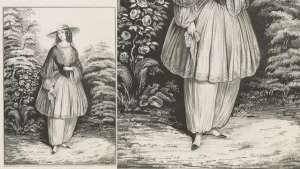
The Metropolitan Museum of Art sets a paper figure in a lacy underdress beside a view of her dressed in plaid. The publisher was Selchow and Righter, the set was called Our Favorite Dolls, and the Met dates it to about 1900. Dress and wearer have separate collection entries. A child could choose a different dress tomorrow without asking the figure to lift an arm.
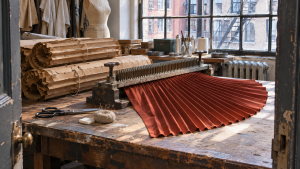
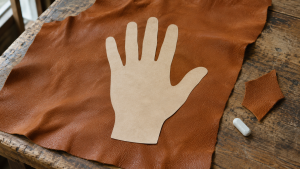
Try the fastening with a piece of scrap card and an outfit cut from ordinary paper. Leave a small tongue of paper sticking out above the shoulder. Hold the dress against the card and crease the tongue over the edge. Turn it round and the work is plain. The tab catches the back of the shoulder, so the dress stays in register with the outline of the figure. Open the crease and the whole outfit can come away in your hand.
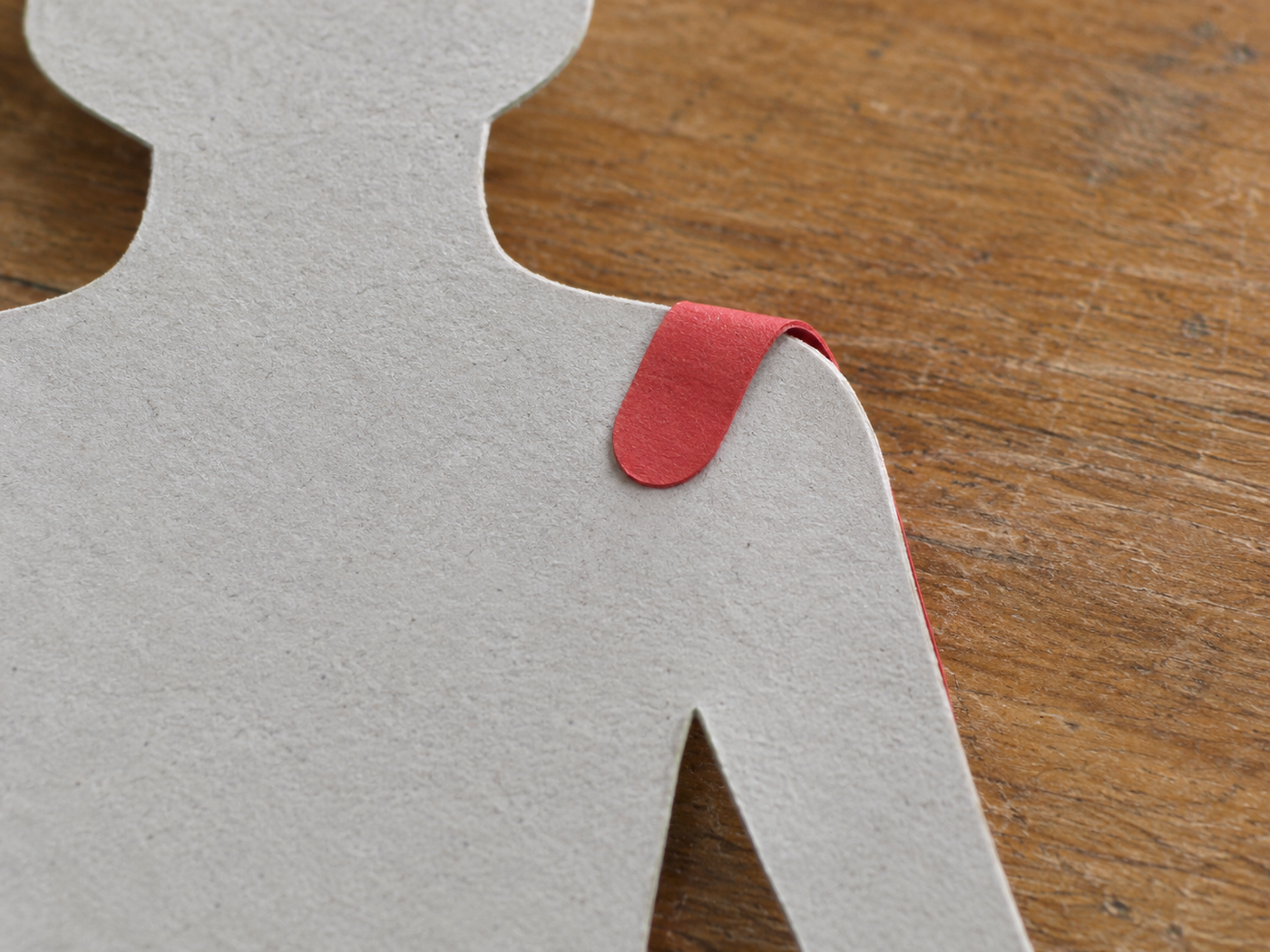
Paper-doll makers came up with other solutions. Some clothes slipped over a paper head through a cut opening. Once you read a paper wardrobe with its original outfits, the outlines start telling you how the toy was meant to work. A slit at a neckline and a tongue on a shoulder ask the child to make quite different movements.
A button you could look straight through
The museum’s photograph of the red suit rewards a front view. A bow sits high on the jacket. Below it, light and shade appear to gather material across the skirt. The museum’s label describes the designer’s use of printed effects to suggest folds and applied decoration. Follow the garment all the way to its outer edge and the white tabs do something the printed shadows can’t. They break the outline against the wall behind the mannequin.
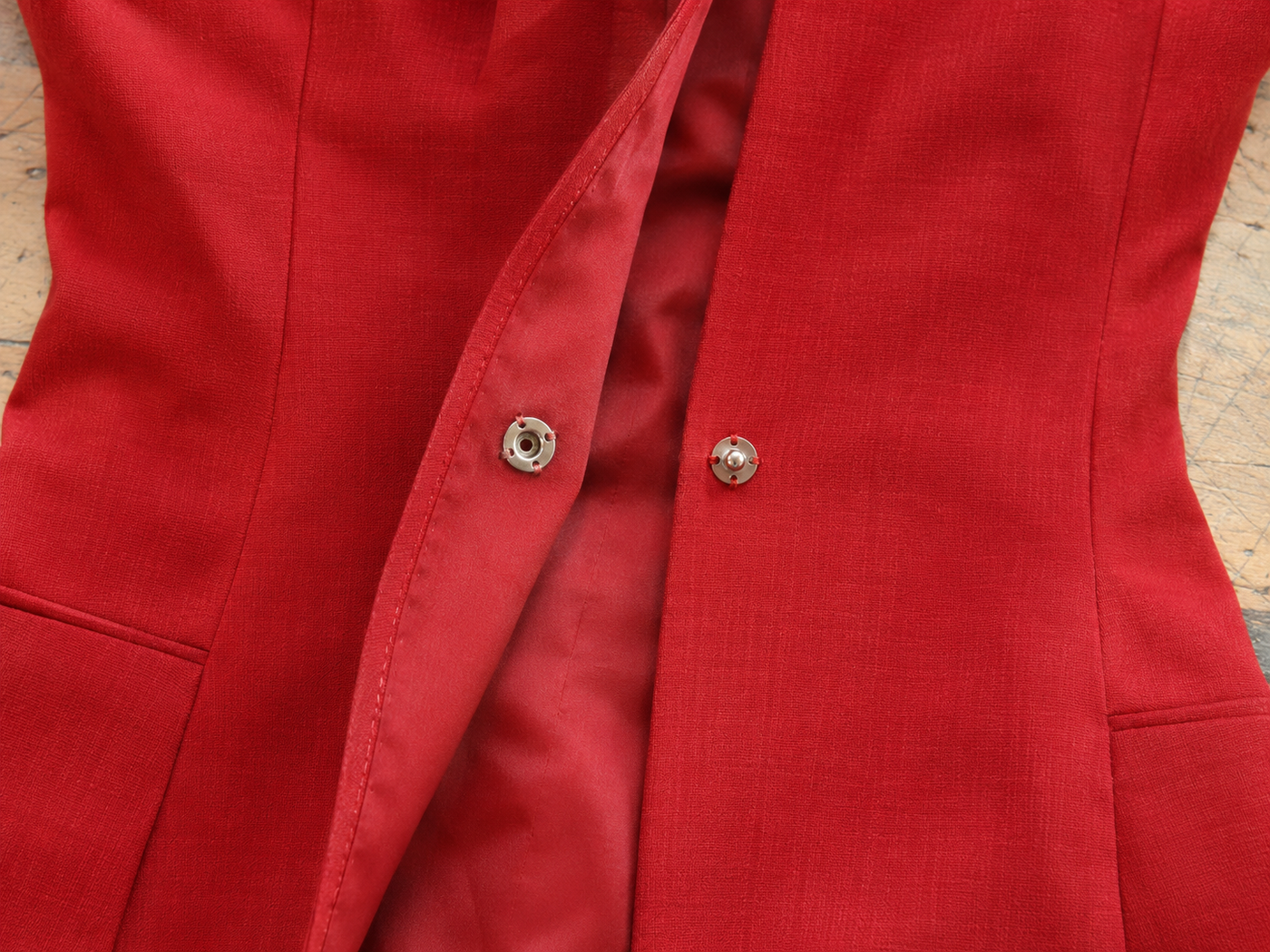
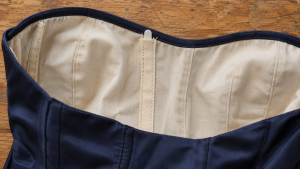
Go back to the jacket opening with the snap in mind. The red circle faces the viewer. The working halves have to face each other between the two fronts. A photograph taken from outside can show where the fronts overlap while hiding the little piece of metal doing the work. The construction detail here illustrates the fastening documented on the matching blazer. The museum’s own photograph is the one to consult for its particular garment. You can use the same way of looking to find what holds up a folded overall bib. Follow the weight back to the layer against the body.
That difference matters to the exhibition’s argument. Scott showed the collection at a time when many people encountered a runway look as a picture on a phone. According to the museum, he was playing with that flat way of seeing clothes. A quick glance gives you a button, a bow and cloth apparently swept up to one side. An extra moment gives you a wearer who had to get into a real jacket and skirt. The picture worked before you had settled which parts were solid.
The museum scheduled Doll Dressing to run through January 3, 2027. In the gallery or in the press photograph, pick one of the white tabs and follow it back to the skirt. Then do the same with the red circle on the jacket. One ends at a physical edge. The other leads your eye to a fastening you have to imagine opening.